
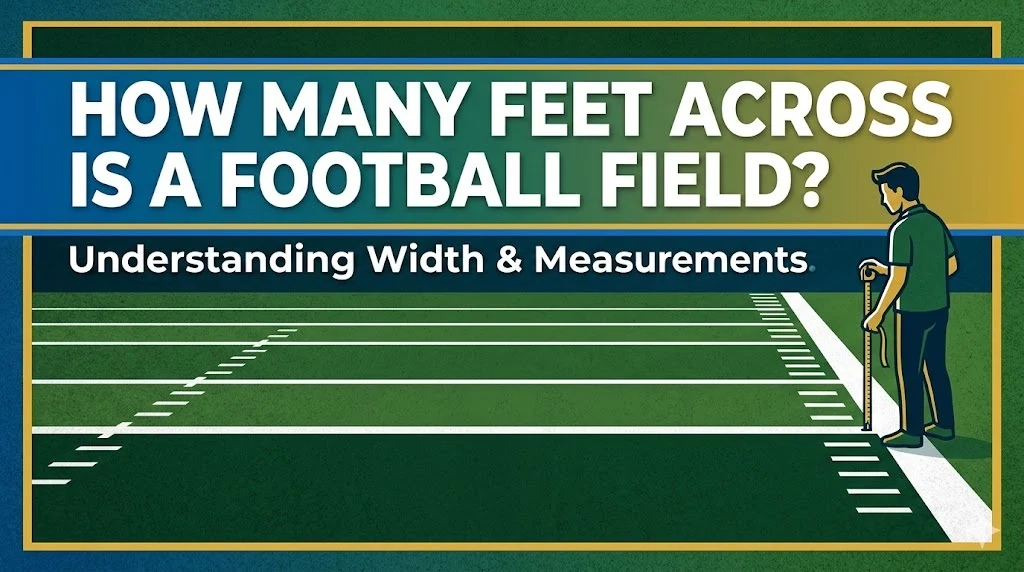
If you have ever watched a football game or visited a stadium, you may have wondered: how many feet across is a football field? This is one of the most common sports measurement questions, especially for students, sports fans, and people trying to visualize large distances.
The official width of a standard American football field is 160 feet across. That equals 53.3 yards wide. This measurement is used in the NFL, college football, and most high school football fields in the United States.
While the width is important, there is much more to understand about football field dimensions. In this guide, you will learn the exact measurements, how they compare to other sports fields, and why these numbers matter.
The Official Width of a Football Field
Width in Feet
A regulation football field is:
53.3 yards=160 feet
That means the distance from one sideline to the other is 160 feet.
This width remains the same for:
- NFL football fields
- College football fields
- Most high school football fields
The width creates enough space for offensive plays, defensive formations, and player movement during games.
Width in Yards
Football fields are traditionally measured in yards rather than feet.
The official width is:
- 53.3 yards
- Or 53 yards and 1 foot
Since:
- 1 yard = 3 feet
The conversion becomes:
- 53.3 × 3 = approximately 160 feet
Why the Width Matters
The width of a football field affects:
- Passing routes
- Running plays
- Defensive coverage
- Kicking angles
- Player spacing
A wider field creates more room for strategy and movement. Coaches often design plays based on the available field width.
Full Football Field Dimensions Explained
Many people confuse the width with the total size of the field. To fully understand football field measurements, you should know all the main dimensions.
Total Length
The total length of a football field, including end zones, is:
120 yards=360 feet
This includes:
- 100-yard playing field
- Two 10-yard end zones
End Zones
Each end zone is:
- 10 yards deep
- 30 feet long
There are two end zones, one at each end of the field.
Playing Area
The main playing area between the goal lines is:
- 100 yards long
- 300 feet long
This is where most gameplay happens.
Football Field Measurements Chart
| Football Field Part | Yards | Feet |
|---|---|---|
| Width | 53.3 yards | 160 feet |
| Playing Length | 100 yards | 300 feet |
| End Zone Length | 10 yards | 30 feet |
| Total Field Length | 120 yards | 360 feet |
| Goal Post Width | 18.5 feet | 18.5 feet |
This chart helps simplify football field measurements for quick reference.
NFL vs College vs High School Football Field Sizes
One surprising fact is that football field dimensions are very similar across different levels of play.
NFL Field Dimensions
An NFL field measures:
- 160 feet wide
- 360 feet long including end zones
The NFL follows strict field regulations to ensure consistency across stadiums.
College Football Dimensions
College football fields use nearly identical dimensions:
- Width: 160 feet
- Total length: 360 feet
However, some markings and hash marks differ from the NFL.
High School Football Dimensions
Most high school football fields also follow:
- 160 feet width
- 360 feet total length
Smaller schools may occasionally have slight variations, but standard measurements are common.
Why Football Fields Are Measured in Yards
History of Yard Measurements
American football evolved from rugby and early field games that used yards as the standard measurement system.
Over time:
- Yard lines became central to gameplay
- First downs were measured in yards
- Field dimensions remained yard-based
That is why football still uses yards instead of feet or meters.
Converting Yards to Feet
The basic formula is:
1 yard=3 feet
Examples:
- 10 yards = 30 feet
- 50 yards = 150 feet
- 53.3 yards = 160 feet
This simple conversion helps when visualizing football field size.
How Big Is a Football Field Compared to Everyday Objects?
Large measurements can feel hard to imagine. Comparing a football field to familiar objects makes it easier.
Compared to Basketball Courts
A standard basketball court is:
- 94 feet long
- 50 feet wide
A football field is much larger:
- More than 3 basketball courts long
- Over 3 times wider than many driveways
Compared to Houses
The average house width is about:
- 40 to 60 feet
A football field at 160 feet across is roughly:
- Equal to 3 or 4 average homes side by side
Compared to Soccer Fields
Soccer fields vary in size, but many are:
- Wider than football fields
- Between 150 and 300 feet wide
Football fields are more standardized.
Understanding the Parts of a Football Field
A football field contains several important markings and sections.
Yard Lines
Yard lines appear every 5 yards across the field.
These lines help:
- Measure progress
- Track downs
- Position players
Hash Marks
Hash marks are smaller markings near the center of the field.
They determine:
- Ball placement after each play
- Starting position for the next snap
Sidelines
The sidelines run the full length of the field.
The 160-foot width is measured from:
- One sideline
- To the opposite sideline
Goal Posts
Goal posts sit at the back of each end zone.
NFL goal posts are:
- 18 feet 6 inches wide
Field goal kickers rely heavily on field dimensions when aiming kicks.
Common Mistakes People Make About Football Field Size
People often misunderstand football field dimensions. Here are some common mistakes.
Confusing Length and Width
Many assume “across” means length.
But:
- Across = width = 160 feet
- Length = 360 feet including end zones
Forgetting End Zones
Some people think the field is only 100 yards long.
In reality:
- Total length = 120 yards including end zones
Using Soccer Field Measurements
Soccer fields vary widely in size, but football fields are much more standardized.
Practical Uses of Football Field Measurements
Football field dimensions are useful outside sports too.
Construction and Planning
Builders and planners use football fields to estimate:
- Land size
- Parking lot space
- Event areas
For example:
- “The property is about half a football field wide.”
Fitness and Training
Athletes use football fields for:
- Sprint training
- Conditioning drills
- Endurance workouts
Knowing the exact dimensions helps track distances accurately.
Education and Sports Analysis
Teachers and coaches often use football field measurements to explain:
- Math conversions
- Geometry concepts
- Sports analytics
Expert Tips for Remembering Football Field Dimensions
Remembering football field measurements becomes easier with a few tricks.
Tip 1: Remember the Key Numbers
Focus on:
- 160 feet wide
- 360 feet long
- 100-yard playing area
These numbers cover most football field questions.
Tip 2: Use Yard-to-Feet Conversion
Keep this simple rule in mind:
feet=yards×3
This makes conversions quick and easy.
Tip 3: Visualize Real Objects
Imagine:
- 3 houses side by side
- Multiple basketball courts
- A large parking lot
These comparisons make the dimensions easier to picture.
FAQs
1. How many feet across is a football field exactly?
A standard football field is exactly 160 feet across, which equals 53.3 yards wide.
2. How long is a football field in feet?
Including end zones, a football field is 360 feet long.
3. Are NFL and college football fields the same size?
Yes. Both NFL and college football fields are generally:
- 160 feet wide
- 360 feet long including end zones
4. How wide is a football field compared to a soccer field?
Most soccer fields are wider than football fields, although soccer field dimensions can vary.
5. Why are football fields measured in yards instead of feet?
Football traditionally uses yards because the sport evolved from earlier games that used the yard-based measurement system.
Conclusion
So, how many feet across is a football field? The official answer is 160 feet wide, or 53.3 yards across. This standard measurement applies to NFL, college, and most high school football fields.
Understanding football field dimensions helps with:
- Sports knowledge
- Distance visualization
- Fitness training
- Educational projects
- Stadium planning
Whether you are a student, coach, sports fan, or simply curious, knowing the size of a football field gives you a better appreciation of the game and the scale of the playing area.