

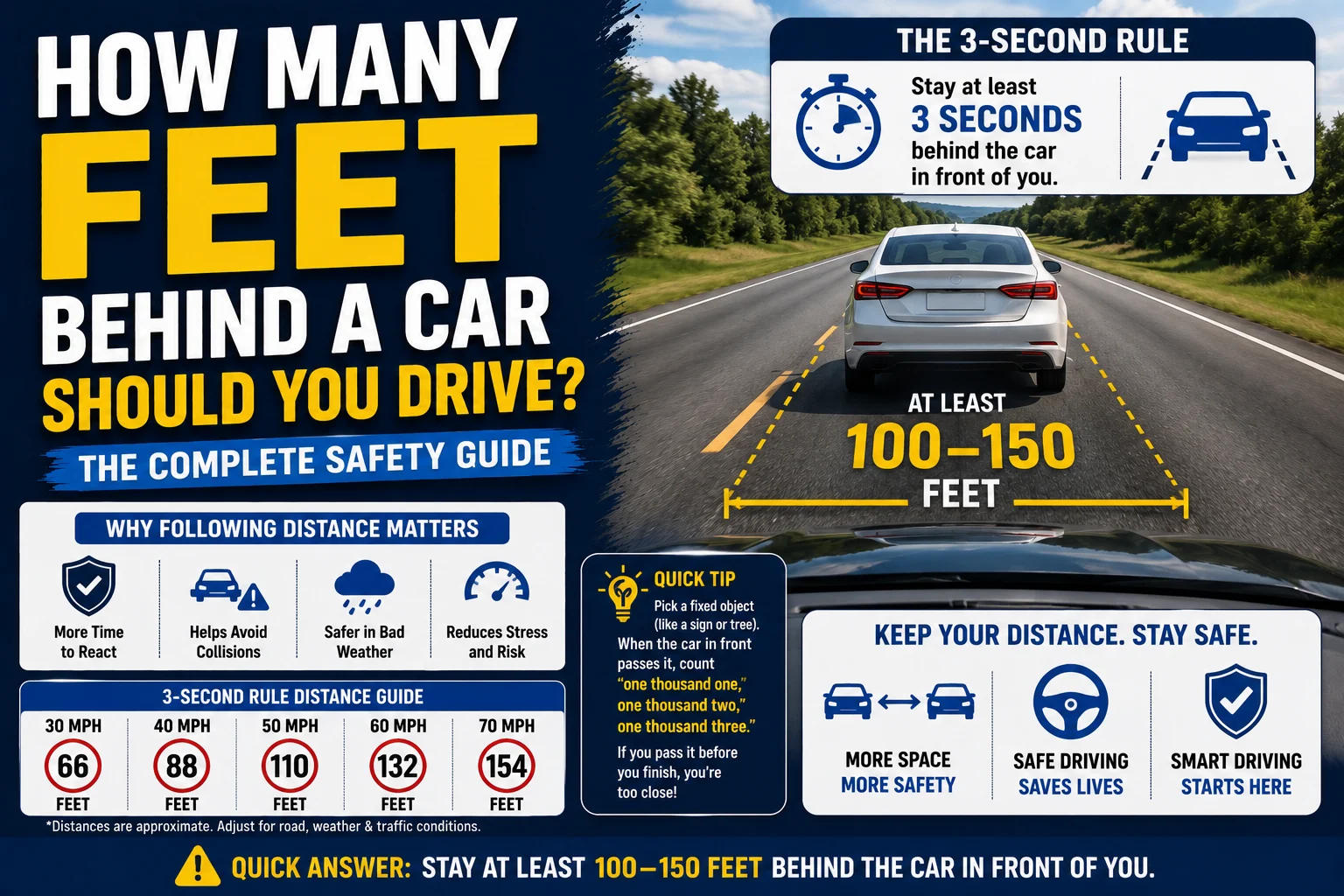
Whether you’re a new driver or simply brushing up on road safety, you may wonder: how many feet behind a car should you drive?
There is no single number that works in every situation because the safe distance depends on your speed, road conditions, weather, and traffic. Instead of measuring a fixed number of feet, driving experts recommend following the three-second rule.
Under normal conditions, you should stay at least three seconds behind the vehicle in front of you. At higher speeds or in poor weather, you should increase that distance to four, five, or even six seconds.
In this guide, you’ll learn how to calculate a safe following distance and why maintaining enough space is essential.
Quick Answer: How Many Feet Behind a Car Should You Stay?
Most driver education programs recommend:
- At least 3 seconds behind another vehicle in normal conditions.
- 4–6 seconds in rain, snow, or heavy traffic.
- More distance at highway speeds.
Approximate distances include:
| Speed | Recommended Distance |
|---|---|
| 25 mph | 110 feet |
| 35 mph | 155 feet |
| 45 mph | 200 feet |
| 55 mph | 240 feet |
| 65 mph | 285 feet |
These distances are estimates and may vary depending on road conditions.
The Three-Second Rule Explained
The safest way to determine how far behind another vehicle you should drive is to use the three-second rule.
Here’s how it works:
- Watch the vehicle in front pass a fixed object, such as a sign or tree.
- Begin counting: “One thousand one, one thousand two, one thousand three.”
- If you pass the object before finishing the count, you’re following too closely.
The three-second rule gives you enough time to react if the driver ahead brakes suddenly.
Why Is Following Distance Important?
Keeping enough space behind another vehicle helps you:
- Avoid rear-end collisions.
- React to sudden stops.
- Improve visibility.
- Drive more comfortably.
- Reduce stress in traffic.
Tailgating is one of the leading causes of highway accidents.
Safe Following Distance by Speed
As your speed increases, your stopping distance also increases.
| Speed | Approximate Following Distance |
| 20 mph | 90 feet |
| 30 mph | 130 feet |
| 40 mph | 175 feet |
| 50 mph | 220 feet |
| 60 mph | 265 feet |
| 70 mph | 310 feet |
Higher speeds require more time and space to stop safely.
When Should You Increase Your Distance?
You should add extra space when:
- Driving in rain.
- Driving in fog.
- Driving on icy roads.
- Towing a trailer.
- Carrying heavy loads.
- Driving at night.
- Following motorcycles.
Under poor conditions, experts recommend at least four to six seconds of following distance.
How Long Is 100 Feet?
To visualize 100 feet:
- About six to seven average cars.
- Roughly one-third of a football field.
- Around 30 meters.
Many drivers underestimate how much space they need to stop safely.
Stopping Distance vs. Following Distance
Following distance and stopping distance are not the same.
- Following distance is the space between your car and the vehicle ahead.
- Stopping distance is the total distance needed to react and stop completely.
Stopping distance includes:
- Reaction time.
- Braking distance.
- Road conditions.
Common Tailgating Mistakes
Avoid these common driving mistakes:
- Driving too close in traffic.
- Ignoring weather conditions.
- Following trucks too closely.
- Distracted driving.
- Braking suddenly.
Leaving extra space helps protect everyone on the road.
Special Rules for Highway Driving
Highway speeds require longer distances.
At 65–70 mph, drivers should:
- Maintain at least three seconds of space.
- Increase to four or five seconds in bad weather.
- Leave extra room behind large trucks.
High-speed collisions can be extremely dangerous.
FAQs
How many feet behind a car should you drive?
The safest approach is to follow the three-second rule, which usually equals about 100–300 feet depending on speed.
What is the three-second rule?
The three-second rule means staying at least three seconds behind the vehicle in front of you.
How far behind a car should you stay at 60 mph?
At 60 mph, a safe distance is approximately 265 feet under normal conditions.
Should I leave more space in bad weather?
Yes. Rain, snow, and fog require a greater following distance.
Is tailgating illegal?
In many places, yes. Following too closely can result in traffic tickets.
How many car lengths equal a safe distance?
The number of car lengths varies with speed, but it is often several car lengths at city speeds and much more on highways.
Why is following distance important?
A safe following distance gives you time to react and avoid accidents.
Quick Facts
- Drivers should follow the three-second rule.
- Highway speeds require more distance.
- Rain and snow increase stopping distance.
- Tailgating is a common cause of crashes.
- Safe following distances often range from 100 to 300 feet.
Final Thoughts
There is no single number of feet that works in every driving situation. The safest method is to use the three-second rule and increase your distance when weather or traffic conditions worsen.
Maintaining enough space behind the vehicle ahead gives you more time to react, reduces stress, and helps keep everyone safe on the road.