

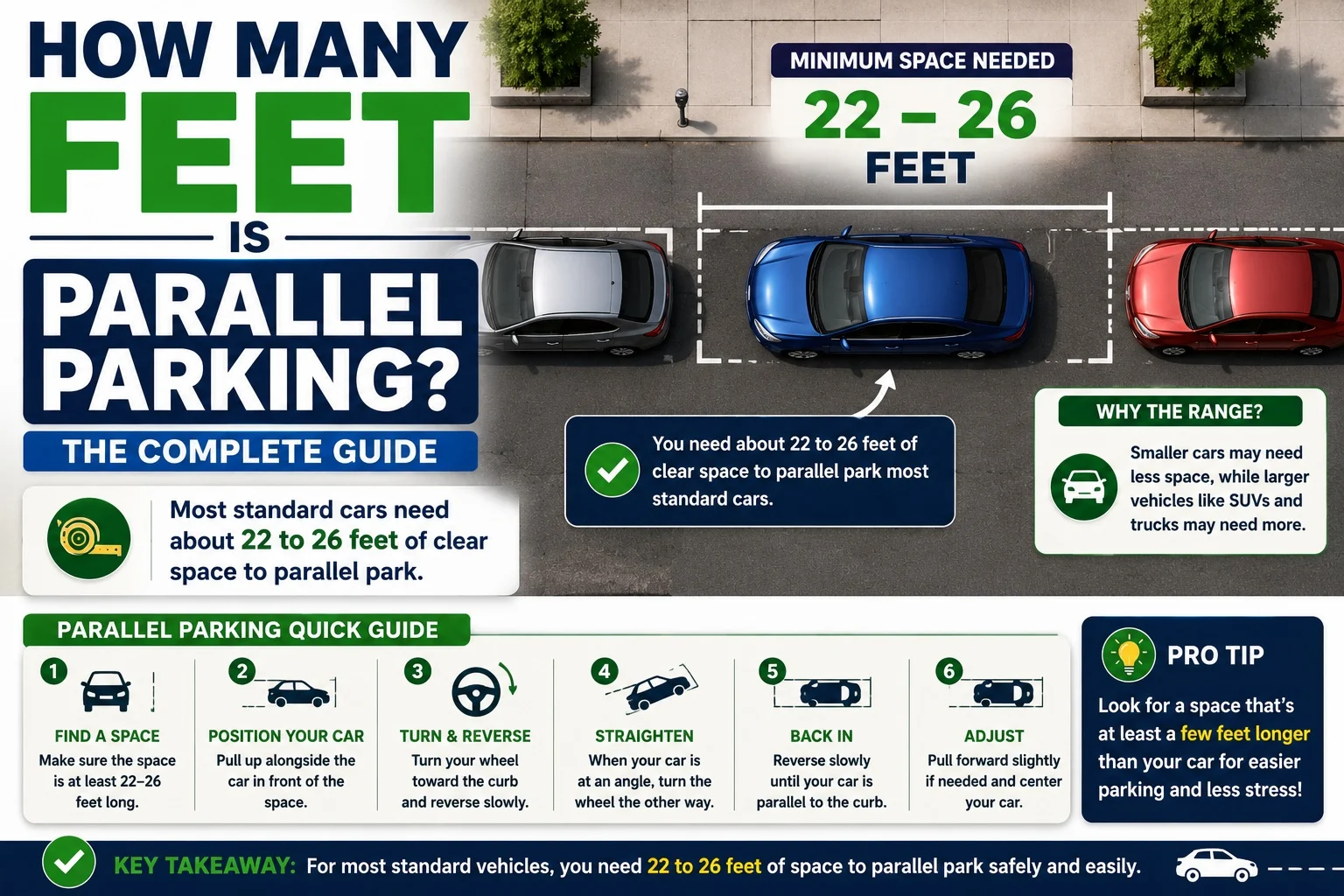
Parallel parking is one of the most important driving skills, especially in urban areas where parking spaces are limited. One of the most common questions new drivers ask is:
How many feet is parallel parking?
The answer isn’t a single fixed number because parallel parking space requirements depend on vehicle size, local regulations, and whether you are learning, testing, or parking in real-world conditions. However, there are standard measurements used by city planners and driving examiners that can help you understand how much space you actually need.
In this guide, we’ll break down standard parallel parking dimensions in feet, how much space different cars need, driving test expectations, and practical tips for successful parking.
Quick Answer
A standard parallel parking space is typically:
20 to 30 feet long
In most real-world conditions:
22 to 26 feet
is considered the minimum comfortable range for a typical passenger vehicle.
However, larger vehicles may require:
28 to 33 feet
for safe and easy parking.
What Is Parallel Parking?
Parallel parking is a method of parking a vehicle parallel to the curb, typically between two parked cars.
It is commonly used in:
- City streets
- Tight urban areas
- Residential parking zones
- Driving tests
Unlike angled parking, parallel parking requires precise steering and space judgment.
Standard Parallel Parking Dimensions
Most transportation authorities design parking spaces based on average car sizes.
Standard Length
A typical parallel parking space is:
22 to 25 feet long
Standard Width
The curb-to-traffic lane distance (width) is usually:
7 to 9 feet wide
This width must accommodate:
- Car width
- Door opening space
- Clearance from curb and traffic lane
Why Parallel Parking Is Measured in Feet
Feet are used because:
- Cars are measured in feet
- Road planning uses imperial units in many countries
- It provides precision for spacing and safety
Instead of thinking in square feet, parallel parking focuses on:
Linear length along the curb
Average Car Size for Comparison
To understand parking space requirements, consider average vehicle length:
Compact Cars
14 to 16 feet long
Sedans
15 to 18 feet long
SUVs
16 to 20 feet long
Pickup Trucks
18 to 22 feet long
This is why parking spaces must be longer than the car itself.
Minimum Space Needed for Parallel Parking
To park comfortably, you need space for:
- Your car length
- Front buffer space
- Rear buffer space
- Maneuvering room
A practical formula is:
Car length+6 to 8 feet clearance
Example:
If a car is 16 feet long:
16+8=24 feet
So a 24-foot space is ideal.
Driving Test Parallel Parking Requirements
During driving exams, instructors often require tighter spaces to test skill.
Typical test dimensions:
20 to 24 feet
This ensures drivers can handle realistic tight parking situations.
Real-World Street Parking Sizes
City street parking varies widely.
Older Cities
- Narrow streets
- Shorter parking spaces
- Sometimes under 20 feet
Modern Cities
- Standardized spaces
- 22–26 feet typical
Suburban Areas
- More generous spacing
- 25–30 feet common
Step-by-Step Parallel Parking Space Breakdown
A full parking space includes:
1. Approach Space
Allows driver to align vehicle.
2. Parking Slot
Main area where the car fits.
3. Buffer Zones
Front and rear safety clearance.
Total combined length:
22 to 30 feet total
How to Tell If a Space Is Big Enough
A simple rule:
If the space is at least 1.5 times your car length, it is usually safe.
Example:
Car length:
16 feet
Required space:
16×1.5=24 feet
Types of Parallel Parking Spaces
1. Standard Street Parking
- 22–25 feet
- Designed for sedans
2. Compact Parking Zones
- 18–22 feet
- Used in dense urban areas
3. Oversized Vehicle Parking
- 26–33 feet
- For SUVs and trucks
Common Parallel Parking Mistakes
1. Underestimating Space
Drivers often misjudge vehicle length.
2. Not Checking Clearance
Too close to curb or other cars.
3. Poor Angle Entry
Incorrect alignment makes parking harder.
4. Rushing the Maneuver
Parallel parking requires patience and control.
Tips for Easier Parallel Parking
Use Reference Points
Align mirrors and bumpers with other vehicles.
Check Mirror Angles
Ensure safe clearance on both sides.
Practice in Large Spaces First
Build confidence before tight areas.
Turn Wheels Gradually
Smooth steering improves control.
How Much Space Beginners Need
New drivers often need extra space:
26 to 30 feet
for easier maneuvering.
Parallel Parking vs Angle Parking
| Type | Space Needed |
|---|---|
| Parallel Parking | 22–30 ft |
| Angle Parking | 10–18 ft |
| Perpendicular Parking | 18–20 ft |
Parallel parking requires the most precision.
Why Parallel Parking Is Important
It helps drivers:
- Park in crowded cities
- Develop spatial awareness
- Improve vehicle control
- Pass driving exams
FAQs
How many feet is a parallel parking space?
Typically 22 to 26 feet
How many feet do you need to parallel park a car?
22 to 28 feet
depending on car size.
Can a truck fit in a standard parallel parking space?
Sometimes, but it may require:
28 to 33 feet
for comfort.
What is the shortest legal parking space?
Some older cities allow spaces under:
20 feet
Conclusion
So, how many feet is parallel parking?
The answer is:
A typical parallel parking space is about 22 to 30 feet long, with most standard cars fitting comfortably in 24 to 26 feet.
While compact cars can fit into tighter spaces, larger vehicles require more room. Understanding these measurements helps drivers park safely, pass driving tests, and navigate city streets with confidence. With practice and awareness of space requirements, parallel parking becomes a simple and manageable driving skill.