
If you are asking how many square feet in a pallet, the answer depends entirely on what material is stacked on the pallet.
A pallet is simply a platform used to transport products. The square footage covered by one pallet varies widely depending on whether it contains:
- Sod
- Pavers
- Hardwood flooring
- Tile
- Drywall
- Bricks
So there is no single universal number.
Quick Answer
Typical pallet coverage by material:
- Pallet of sod: 400–500 square feet
- Pallet of pavers: 80–120 square feet
- Pallet of hardwood flooring: 500–700 square feet
- Pallet of tile: 200–600 square feet
The most common search intent is often related to sod, where one pallet usually covers about 450 square feet.
Why There Is No Single Answer
A pallet measures transportation size, not area.
The same pallet dimensions can hold:
- Thin, lightweight materials
- Heavy dense materials
- Thick products with limited stacking height
Because products differ in size and weight, square footage per pallet varies dramatically.
Standard Pallet Dimensions
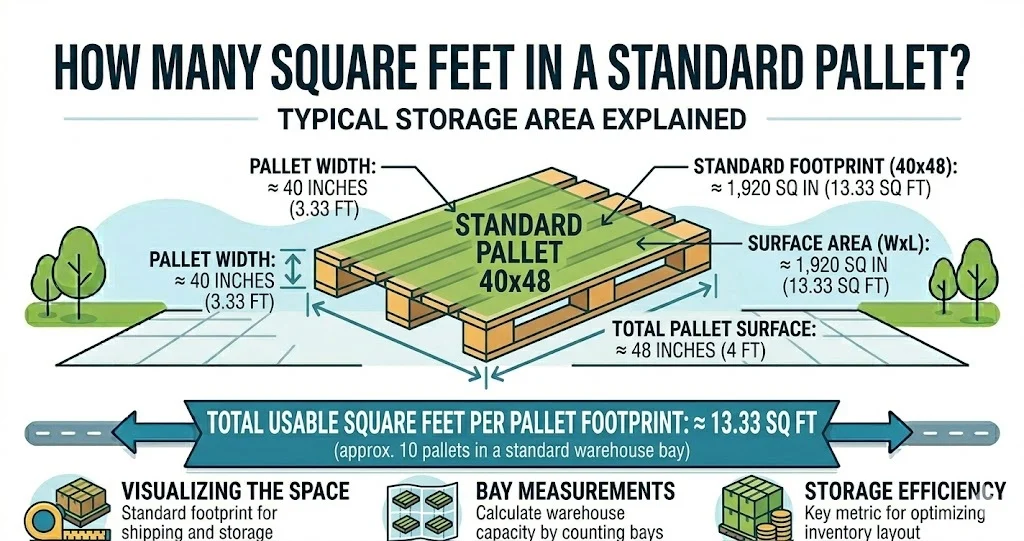
A typical shipping pallet in North America measures:
- 48 inches × 40 inches
48×40=1,920 square inches
Convert to square feet:
1,920÷144=13.33 square feet
Important: this is only the footprint of the pallet itself, not the coverage of the material loaded on it.
Pallet of Sod Coverage
A pallet of sod is one of the most common uses of the term.
Typical coverage:
- 400 to 500 square feet
- Average used by many suppliers: 450 square feet
This is enough to cover a moderate-sized yard.
Pallet of Pavers Coverage
Paver coverage depends on paver thickness and weight.
Typical range:
- 80 to 120 square feet
Heavy concrete pavers cover less area because weight limits restrict stacking.
Pallet of Hardwood Flooring Coverage
Flooring cartons are stacked on pallets.
Typical coverage:
- 500 to 700 square feet
Actual coverage depends on board thickness and packaging.
Pallet of Tile Coverage
Ceramic and porcelain tile pallets vary considerably.
Typical range:
- 200 to 600 square feet
Large-format tiles and thicker stone products cover less area per pallet.
Coverage Comparison Table
| Material Type | Typical Square Feet per Pallet |
|---|---|
| Sod | 400–500 sq ft |
| Pavers | 80–120 sq ft |
| Hardwood flooring | 500–700 sq ft |
| Tile | 200–600 sq ft |
| Brick | 100–150 sq ft |
Real-World Examples
Lawn Installation
One pallet of sod can cover about 450 square feet, enough for a 15 × 30 foot area.
Patio Construction
A pallet of pavers may cover around 100 square feet.
Flooring Project
One pallet of hardwood could cover several rooms in a small home.
How to Calculate Coverage Yourself
Use this formula:
Coverage=Quantity×Area Per Unit
For example, if a pallet contains 500 sod pieces and each piece covers 0.9 square feet, total coverage is 450 square feet.
Common Mistakes
Assuming Every Pallet Covers the Same Area
Coverage depends entirely on the product.
Confusing Pallet Footprint With Material Coverage
The pallet itself occupies only about 13.3 square feet.
Ignoring Waste
Installation often requires extra material.
Not Checking Supplier Specifications
Manufacturers may package products differently.
Expert Tips
Always Verify With the Supplier
Packaging can vary by brand and region.
Order Extra Material
Add 5% to 15% for cuts and waste.
Measure Your Project First
Accurate dimensions prevent over- or under-ordering.
Consider Weight and Delivery Access
Pallets can weigh thousands of pounds.
FAQs
1. How many square feet in a pallet of sod?
Typically 400 to 500 square feet, with 450 square feet being common.
2. How many square feet in a pallet of pavers?
Usually 80 to 120 square feet.
3. How many square feet in a pallet of flooring?
Often 500 to 700 square feet.
4. How large is a standard pallet?
About 48 × 40 inches, or 13.33 square feet in footprint.
5. Is pallet coverage always the same?
No. Coverage depends on the material and packaging.
Conclusion
So, how many square feet in a pallet?
The answer depends on the material, but common examples include:
- Sod: 400–500 square feet
- Pavers: 80–120 square feet
- Flooring: 500–700 square feet
The term “pallet” describes how materials are packaged and transported, not a fixed amount of coverage. Always check the manufacturer’s specifications and add extra material for waste to ensure your project goes smoothly.