
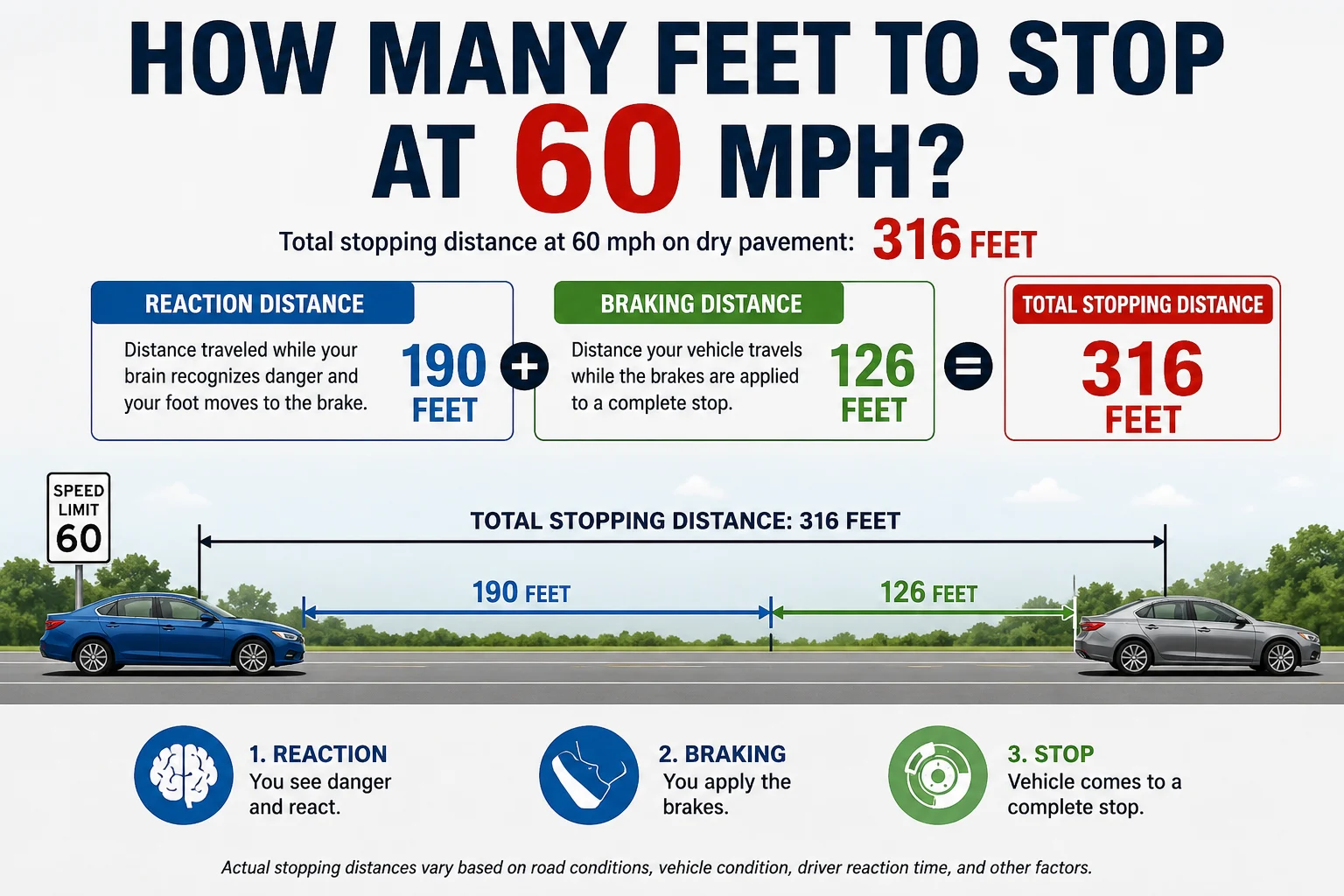
If you have ever wondered how many feet to stop at 60 mph, the short answer is that most vehicles need around 240 to 300 feet to come to a complete stop under normal driving conditions.
That distance includes both:
- The driver’s reaction distance
- The vehicle’s braking distance
Many drivers underestimate how far a car travels before stopping. At highway speeds, even a small delay in reaction time can add dozens of feet to the total stopping distance.
Understanding stopping distance is important for:
- Safe highway driving
- Avoiding rear-end collisions
- Defensive driving
- Driver education tests
- Driving in bad weather
In this guide, you will learn exactly how stopping distance works at 60 mph, what factors change it, and how to stay safer on the road.
Understanding Stopping Distance
Before calculating how many feet to stop at 60 mph, it helps to understand the three parts of stopping distance.
What Is Reaction Distance?
Reaction distance is the distance your vehicle travels from the moment you notice a hazard until you press the brake pedal.
Even alert drivers need time to react.
At 60 mph, a vehicle travels about 88 feet per second. That means even a one-second delay adds a large amount of distance.
Examples of reaction delays include:
- Looking at a phone
- Fatigue
- Daydreaming
- Adjusting the radio
- Bad weather visibility
What Is Braking Distance?
Braking distance is the distance the car travels after the brakes are applied until the vehicle completely stops.
This depends on:
- Brake quality
- Tire traction
- Vehicle weight
- Road conditions
- Speed
Total Stopping Distance Explained
Total stopping distance equals:
- Reaction distance
- Plus braking distance
At 60 mph, both parts together create a much longer stopping distance than many drivers expect.
How Many Feet to Stop at 60 MPH?
The average stopping distance at 60 mph is approximately:
| Type of Distance | Approximate Feet |
|---|---|
| Reaction Distance | 130–150 feet |
| Braking Distance | 110–160 feet |
| Total Stopping Distance | 240–310 feet |
Under ideal dry road conditions, many driving safety organizations estimate around 240 to 250 feet total.
However, poor weather or delayed reactions can increase this significantly.
Average Stopping Distance in Dry Conditions
A typical passenger car on dry pavement may stop from 60 mph in roughly:
- 4.5 to 5 seconds
- About 240 to 250 feet
That is close to the length of:
- Two-thirds of a football field
- About 16 average cars lined up
Why Distances Vary
Not all vehicles stop equally.
For example:
- Sports cars often stop faster
- Trucks usually require more distance
- SUVs may take longer due to weight
Driver attention also matters. A distracted driver can easily add another 100 feet before braking even begins.
Reaction Distance at 60 MPH
Reaction distance plays a huge role in stopping safely.
Average Human Reaction Time
Most driving studies estimate average reaction time at:
- 1.5 seconds
At 60 mph, your car travels:
60 mph≈88 feet per second
That means during a 1.5-second reaction:
88×1.5=132 feet
So before your foot even touches the brake pedal, your car may already travel over 130 feet.
How Far You Travel Before Braking
Here is how distraction affects stopping distance:
| Reaction Time | Distance Traveled at 60 MPH |
|---|---|
| 1 second | 88 feet |
| 1.5 seconds | 132 feet |
| 2 seconds | 176 feet |
| 3 seconds | 264 feet |
Looking at your phone for just three seconds at 60 mph means your vehicle travels nearly an entire football field before braking.
Braking Distance at 60 MPH
After reaction comes braking distance.
Typical Braking Distance
On dry roads, most modern passenger vehicles need:
- 110 to 160 feet
to stop once brakes are fully applied.
High-performance brakes and good tires can shorten this distance.
How Brakes and Tires Affect Results
Several things impact braking performance:
Good Tires
Fresh tires with strong tread grip the road better.
Worn Brakes
Old brake pads increase stopping distance.
ABS Systems
Anti-lock brakes help maintain control during emergency braking.
Tire Pressure
Incorrect tire pressure reduces traction.
Factors That Affect Stopping Distance
Many conditions can change how many feet it takes to stop at 60 mph.
Weather Conditions
Rain, snow, and ice greatly increase stopping distance.
| Road Condition | Estimated Stopping Distance |
|---|---|
| Dry pavement | 240–250 feet |
| Wet pavement | 300–400 feet |
| Snow | 500+ feet |
| Ice | 700+ feet |
Wet roads reduce tire grip, while ice almost eliminates traction completely.
Vehicle Weight
Heavier vehicles carry more momentum.
Examples include:
- Pickup trucks
- Loaded SUVs
- Semi-trucks
These vehicles often need much longer stopping distances.
Tire Quality
Bald tires are dangerous at highway speeds.
Poor tread reduces:
- Water displacement
- Grip
- Cornering control
- Emergency braking ability
Driver Attention
Distracted driving dramatically increases total stopping distance.
Common distractions include:
- Texting
- Eating
- GPS adjustments
- Talking to passengers
Road Surface
Road conditions also matter.
Stopping distances increase on:
- Gravel
- Mud
- Loose dirt
- Uneven pavement
Stopping Distance Chart by Speed
Speed has a major effect on stopping distance.
Here is a general comparison chart:
| Speed | Approximate Total Stopping Distance |
|---|---|
| 20 mph | 40 feet |
| 30 mph | 75 feet |
| 40 mph | 120 feet |
| 50 mph | 175 feet |
| 60 mph | 240–300 feet |
| 70 mph | 315–400 feet |
Notice that stopping distance rises rapidly as speed increases.
Doubling speed does not simply double stopping distance — it increases it much more.
Why Safe Following Distance Matters
Knowing how many feet to stop at 60 mph helps drivers maintain safer following distances.
The Three-Second Rule
Most driving instructors recommend:
- Staying at least three seconds behind the vehicle ahead
In rain or darkness:
- Increase to four or five seconds
This gives enough space to react and stop safely.
Highway Driving Tips
When driving at 60 mph or higher:
- Avoid tailgating
- Scan traffic ahead
- Watch brake lights early
- Keep both hands on the wheel
- Avoid distractions
These habits can prevent serious accidents.
Common Driver Mistakes That Increase Stopping Distance
Many drivers unknowingly make stopping more difficult.
Following Too Closely
Tailgating leaves little room for emergencies.
Driving Too Fast in Rain
Wet roads can double stopping distance.
Ignoring Tire Maintenance
Low tread equals less traction.
Distracted Driving
Even brief distractions can be deadly at highway speeds.
Overloading Vehicles
Heavy cargo increases momentum and braking distance.
Tips to Reduce Your Stopping Distance
You cannot change physics, but you can improve safety.
Maintain Your Brakes
Inspect brakes regularly.
Replace worn:
- Brake pads
- Rotors
- Brake fluid
Keep Tires in Good Shape
Check:
- Tire pressure
- Tread depth
- Alignment
Stay Alert
Avoid:
- Texting
- Fatigue
- Eating while driving
Slow Down in Bad Weather
Reducing speed greatly improves stopping ability.
Increase Following Distance
More space gives more reaction time.
Real-World Example of Stopping at 60 MPH
Imagine driving on a highway at 60 mph.
A vehicle ahead suddenly stops.
Step 1: Reaction
You notice the hazard and react in 1.5 seconds.
During that time, your vehicle travels:
- About 132 feet
Step 2: Braking
Your brakes engage and the car takes another:
- 120 feet
to stop fully.
Total Distance
Your total stopping distance becomes:
132+120=252 feet
If the road is wet, that number may increase to over 350 feet.
Legal and Safety Considerations
Traffic laws generally require drivers to maintain safe stopping distances.
Drivers who rear-end another vehicle are often considered at fault because they failed to stop in time.
Defensive driving courses also teach that:
- Speeding increases crash severity
- Proper spacing prevents accidents
- Reaction time is critical
Modern vehicles include safety technologies like:
- Automatic emergency braking
- Forward collision warnings
- Stability control
However, these systems do not replace careful driving.
Frequently Asked Questions
How many feet does it take to stop at 60 mph?
Most vehicles require about 240 to 300 feet to stop at 60 mph under normal dry conditions.
How long does it take to stop from 60 mph?
A typical car may take around 4.5 to 5 seconds to stop completely.
Does rain increase stopping distance?
Yes. Wet roads reduce traction and can increase stopping distance by 25% to 50% or more.
What affects stopping distance the most?
Major factors include:
- Speed
- Driver reaction time
- Tire condition
- Brake quality
- Road conditions
Is stopping distance longer for trucks?
Yes. Larger and heavier vehicles usually need more distance to stop safely.
Conclusion
So, how many feet to stop at 60 mph?
In most cases, drivers need approximately 240 to 300 feet to stop completely. That distance includes both reaction time and braking distance.
However, real-world conditions like rain, distraction, worn tires, and vehicle weight can dramatically increase stopping distance.
Understanding stopping distance helps drivers:
- Stay safer on highways
- Avoid rear-end collisions
- Improve defensive driving habits
- Maintain safer following distances
The best way to reduce stopping distance is simple:
- Stay alert
- Maintain your vehicle
- Slow down in poor conditions
- Leave enough space between cars
At 60 mph, every second — and every foot — matters.
Discover More Articles
How Many Feet Is 3 Kilometers?