

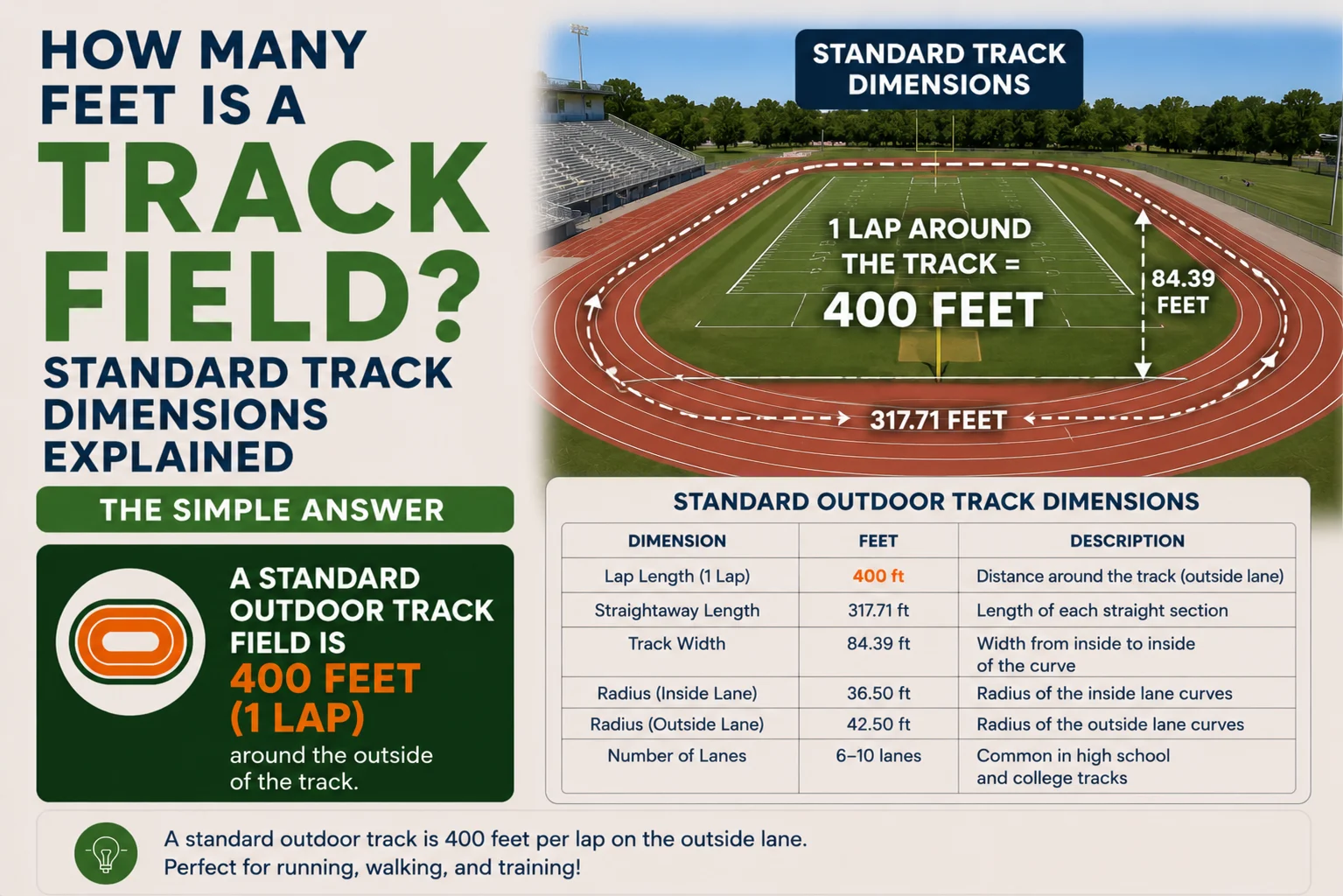
If you’re asking how many feet is a track field, the answer depends on what part of the track you mean. A standard track field is not measured as a single straight distance—it is an oval running track with multiple lane lengths.
However, the most commonly used standard is:
👉 A full Olympic running track is about 1,312 feet (400 meters) around the inside lane.
Quick Answer (Standard Track Size)
400 meters≈1,312 feet (standard track circumference)
👉 One full lap around a standard track = ~1,312 feet
What Is a Track Field?
A track field usually includes:
- A 400-meter running track (oval shape)
- Straightaways (sprint sections)
- Curved bends (turns)
- An infield used for sports like:
- Soccer
- Football
- Javelin
- Long jump
So when people ask “how many feet is a track field,” they usually mean the running track perimeter, not the entire field inside.
Standard Track Dimensions (Olympic Standard)
A regulation track used in Olympics and schools follows this structure:
Key Measurement:
- 1 lap = 400 meters
400×3.281=1,312.4 feet
👉 So the track is approximately 1,312 feet per lap (inside lane)
Lane Lengths Explained
A track has multiple lanes, and each lane is slightly longer than the inside lane.
Lane 1 (inside lane)
- ~1,312 feet per lap
Lane 2
- Slightly longer due to curve expansion
Outer lanes
- Can be 1,330–1,450+ feet per lap
👉 The farther out you go, the longer each lap becomes.
Why Track Length Is Measured in Meters (Not Feet)
Track fields use the metric system because:
- International sports standards (IAAF/World Athletics)
- Easier standardization worldwide
- Olympic competition consistency
So:
- 400 meters = standard lap
- Feet is just a conversion for understanding
What Does 1,312 Feet Look Like?
To visualize a full lap:
- About 4 football fields in length (end-to-end)
- A full walking loop around a large school stadium
- A running lap lasting 60–90 seconds for average joggers
Breakdown of a Track Field Layout
A standard 400m track includes:
Straight Sections
- Two long straightaways
- Each about 100 meters (~328 feet)
Curved Sections
- Two semicircle bends
- Combined complete the oval shape
Common Track Field Uses
Track fields are used for:
- Sprint races (100m, 200m, 400m)
- Long-distance running (800m, 1500m, 5000m)
- School sports events
- Professional athletics
- Physical training and fitness
Track Field vs Soccer Field Size
Many people confuse the two.
| Field Type | Size |
|---|---|
| Track (1 lap) | ~1,312 feet |
| Soccer field length | ~300–360 feet |
| Football field | 360 feet including end zones |
👉 A track completely surrounds a much smaller infield playing field.
How Big Is the Infield?
Inside a track field:
- Length: ~200–240 feet
- Width: ~130–160 feet
Used for:
- Soccer matches
- Field events
- Training drills
Why Track Size Matters
Understanding how many feet is a track field helps with:
- Training distance calculations
- Athletic performance tracking
- Event planning
- School sports setup
- Fitness goal measurement
Common Mistakes People Make
1. Thinking the whole field is one size
Only the track perimeter is standardized.
2. Ignoring lane differences
Outer lanes are longer than inner lanes.
3. Mixing meters and feet incorrectly
Always convert carefully:
- 400 meters ≠ 400 feet
Expert Tips
- Always assume 1 lap = 400 meters = 1,312 feet
- Use lane 1 for consistent measurement
- For training, track distance in laps, not feet
- Remember curves increase distance per lane
FAQs
1. How many feet is a track field?
👉 About 1,312 feet per lap (inside lane).
2. How many feet is a 400-meter track?
👉 400 meters ≈ 1,312 feet
3. Are all track fields the same size?
Most regulation tracks are standard, but older or school tracks may vary slightly.
4. Why are lanes longer on the outside?
Because the outer curve covers a larger radius, increasing distance.
5. How many football fields fit in a track?
The infield is roughly the size of 1 football field, but the track surrounds it.
Conclusion
So, how many feet is a track field?
A standard running track is about 1,312 feet per lap (inside lane), based on the 400-meter Olympic standard.
Track fields are carefully designed for competitive sports, and while the exact distance changes by lane, the inside lane remains the universal measurement reference for athletics worldwide.