

If you are working on a construction, landscaping, or home improvement project, you may wonder: how many feet in 1 cubic yard?
The quick answer is simple:
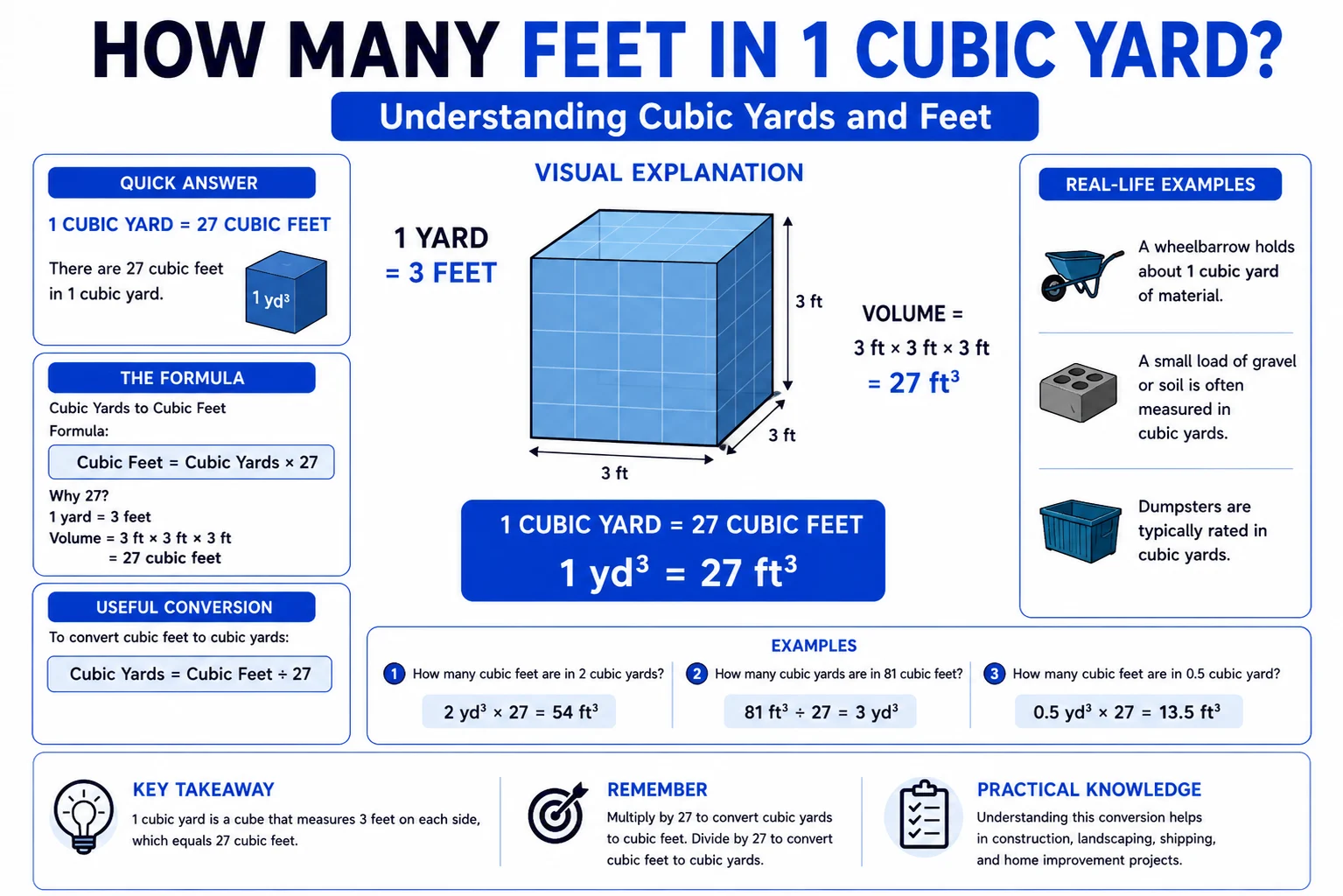
1 cubic yard=27 cubic feet
This conversion is extremely important when buying materials like concrete, gravel, sand, mulch, or soil. Many suppliers sell materials by the cubic yard, while measurements at home are often taken in feet. Understanding the relationship between cubic yards and cubic feet helps you order the right amount and avoid wasting money.
In this guide, you will learn exactly how cubic yard conversions work, how to calculate them easily, practical real-world examples, common mistakes to avoid, and expert tips for accurate measurements.
Understanding Cubic Yards and Cubic Feet
Before learning the conversion, it helps to understand what these measurements mean.
What Is a Cubic Yard?
A cubic yard is a unit of volume used mainly in the United States. It measures three-dimensional space.
A cubic yard is a cube that measures:
- 3 feet long
- 3 feet wide
- 3 feet high
Because each side equals 3 feet, the total volume becomes:
3×3×3=27
That equals 27 cubic feet.
Cubic yards are commonly used for:
- Concrete
- Dirt
- Sand
- Gravel
- Mulch
- Compost
- Demolition debris
What Is a Cubic Foot?
A cubic foot is another unit of volume. It represents a cube measuring:
- 1 foot long
- 1 foot wide
- 1 foot high
Cubic feet are often used for:
- Small landscaping jobs
- Appliance dimensions
- Storage measurements
- Soil bags
- Refrigerator capacity
Since a cubic yard is much larger, understanding the conversion helps compare volumes accurately.
How Many Feet in 1 Cubic Yard?
Here is the exact conversion again:
1 cubic yard=27 cubic feet
This means:
- 1 cubic yard contains 27 cubic feet
- 2 cubic yards contain 54 cubic feet
- 3 cubic yards contain 81 cubic feet
Simple Formula
To convert cubic yards into cubic feet, use this formula:
Cubic Feet=Cubic Yards×27
For example:
2 cubic yards×27=54 cubic feet
To convert cubic feet back into cubic yards:
Cubic Yards=27Cubic Feet
Why the Conversion Matters
Understanding how many feet are in a cubic yard is useful in many situations.
Construction Projects
Builders use cubic yards for:
- Concrete pours
- Foundation work
- Excavation
- Backfilling
If your measurements are in feet but suppliers sell by the yard, conversion becomes essential.
For example, concrete trucks typically charge by cubic yard.
Landscaping Jobs
Landscaping materials are commonly sold in cubic yards, including:
- Mulch
- Topsoil
- Gravel
- Sand
Knowing the conversion helps estimate coverage accurately.
Concrete and Gravel Orders
Ordering too little material can delay your project. Ordering too much wastes money and creates cleanup problems.
Proper conversions help you:
- Save money
- Avoid shortages
- Reduce waste
- Improve project planning
Cubic Yard to Cubic Feet Conversion Chart
Here is a quick reference chart for common conversions:
| Cubic Yards | Cubic Feet |
|---|---|
| 1 | 27 |
| 2 | 54 |
| 3 | 81 |
| 4 | 108 |
| 5 | 135 |
| 10 | 270 |
| 15 | 405 |
| 20 | 540 |
This chart makes quick estimating easier on job sites or home projects.
Step-by-Step Conversion Examples
Real-world examples make the conversion easier to understand.
Example 1: Concrete Project
Suppose you need 4 cubic yards of concrete.
Use the formula:
4×27=108
That means you need:
- 108 cubic feet of concrete
This helps compare truck capacity or calculate slab dimensions.
Example 2: Mulch for Landscaping
You buy 2 cubic yards of mulch.
The conversion becomes:
2×27=54
So you receive:
- 54 cubic feet of mulch
If mulch bags are labeled in cubic feet, you can compare prices more accurately.
Example 3: Soil Calculation
Imagine you have 81 cubic feet of soil and want to know how many cubic yards that equals.
Use the reverse formula:
2781=3
So:
- 81 cubic feet equals 3 cubic yards
Common Materials Measured in Cubic Yards
Many materials are sold by the cubic yard instead of by weight or square footage.
Here are common examples:
| Material | Usually Sold By |
|---|---|
| Concrete | Cubic Yard |
| Gravel | Cubic Yard |
| Sand | Cubic Yard |
| Mulch | Cubic Yard |
| Topsoil | Cubic Yard |
| Compost | Cubic Yard |
| Fill Dirt | Cubic Yard |
These materials are measured by volume because their weight changes depending on moisture and density.
How to Measure Cubic Feet Before Converting
Before converting to cubic yards, you first measure cubic feet.
Use this formula:
Length×Width×Height=Cubic Feet
For example:
- Length = 12 feet
- Width = 6 feet
- Depth = 2 feet
Calculation:
12×6×2=144
That equals:
- 144 cubic feet
Now convert to cubic yards:
27144≈5.33
You would need approximately:
- 5.33 cubic yards
Most suppliers recommend rounding up slightly.
Cubic Yard vs Square Foot
People often confuse cubic yards with square feet.
Here is the difference:
| Measurement | Measures |
|---|---|
| Square Foot | Area |
| Cubic Foot | Volume |
| Cubic Yard | Volume |
Square footage only measures flat surface area.
Cubic measurements include depth or height.
For example:
- A patio may cover 100 square feet
- But if concrete is 4 inches deep, volume must be calculated in cubic feet or cubic yards
This distinction is critical for accurate material ordering.
Practical Coverage Estimates
Coverage depends on material depth.
Here are general estimates for 1 cubic yard:
| Depth | Approximate Coverage |
|---|---|
| 1 inch | 324 square feet |
| 2 inches | 162 square feet |
| 3 inches | 108 square feet |
| 4 inches | 81 square feet |
| 6 inches | 54 square feet |
These estimates help with:
- Mulch spreading
- Gravel installation
- Soil leveling
- Concrete pours
Common Mistakes When Converting Cubic Yards
Even simple conversions can cause problems if done incorrectly.
Forgetting the Difference Between Area and Volume
Many people calculate square feet instead of cubic feet.
Always include depth.
Using Wrong Units
Mixing inches and feet leads to incorrect calculations.
Convert everything into feet before calculating.
Not Rounding Up
Materials settle or compact over time.
Ordering slightly extra prevents shortages.
Ignoring Waste Factors
Some projects lose material during transport or spreading.
Professionals often add:
- 5% extra for simple jobs
- 10% extra for uneven areas
Expert Tips for Accurate Measurements
Professionals use several tricks to improve accuracy.
Measure Twice
Always double-check dimensions before ordering materials.
Sketch the Area
Simple drawings help avoid confusion.
Use Consistent Units
Convert inches into feet before calculations.
For example:
- 6 inches = 0.5 feet
- 4 inches = 0.33 feet
Ask Suppliers About Compaction
Some materials shrink after installation.
Mulch, soil, and gravel may settle over time.
Order Slightly Extra
Running short usually costs more than ordering a little extra.
Real-World Applications of Cubic Yard Conversions
Understanding cubic yard conversions helps in many everyday situations.
Home Renovation
Homeowners use conversions for:
- Raised garden beds
- Driveways
- Patio bases
- Retaining walls
Commercial Construction
Contractors estimate:
- Concrete volumes
- Excavation loads
- Dump truck capacity
Landscaping Businesses
Professionals calculate:
- Mulch coverage
- Soil delivery
- Gravel paths
- Decorative rock placement
The conversion between cubic yards and cubic feet is one of the most common calculations in construction and landscaping.
FAQs
1. How many cubic feet are in 1 cubic yard?
There are 27 cubic feet in 1 cubic yard.
2. Why is a cubic yard equal to 27 cubic feet?
Because one cubic yard measures 3 feet by 3 feet by 3 feet.
3×3×3=27
3. How do I convert cubic yards to cubic feet?
Multiply the number of cubic yards by 27.
4. How many cubic yards are in 54 cubic feet?
Divide 54 by 27.
2754=2
So, 54 cubic feet equals 2 cubic yards.
5. What materials are commonly sold in cubic yards?
Common materials include:
- Concrete
- Gravel
- Sand
- Soil
- Mulch
- Compost
Conclusion
Understanding how many feet in 1 cubic yard is essential for construction, landscaping, and home improvement projects.
The key conversion is simple:
1 cubic yard=27 cubic feet
Once you know this formula, you can confidently estimate materials for concrete, soil, mulch, gravel, and many other projects.
Whether you are a homeowner planning a garden or a contractor managing a large job site, accurate cubic yard conversions save time, reduce waste, and help control costs. By using the formulas, charts, and tips in this guide, you can calculate volume more accurately and avoid common measurement mistakes.