
When planning a heating system for a home, apartment, or office space, one of the most important questions is:
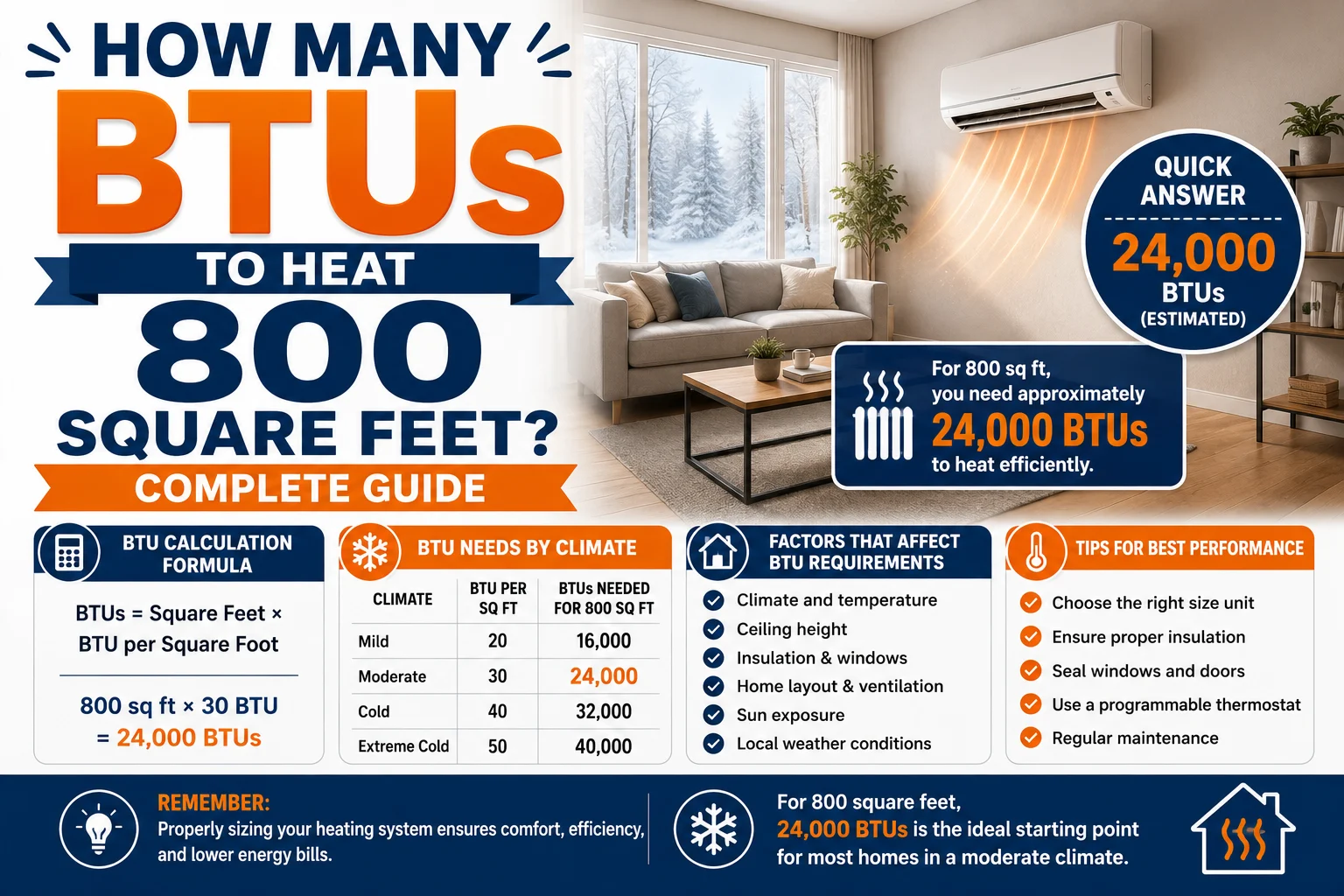
How many BTUs are needed to heat 800 square feet?
BTU stands for British Thermal Unit, and it is the standard measurement used in heating and cooling systems to determine how much energy is required to change air temperature.
Whether you’re installing a space heater, furnace, or HVAC system, understanding BTU requirements helps you choose the right size unit—avoiding both underheating and wasted energy.
In this guide, we’ll break down exactly how many BTUs you need for 800 square feet, the factors that affect heating needs, and how to calculate it yourself accurately.
Quick Answer
For a standard insulated home, the general rule is:
20 BTUs per square foot
So for 800 square feet:
800×20=16,000 BTUs
Final Answer:
You need approximately 16,000 BTUs to heat 800 square feet
What Is a BTU?
A BTU (British Thermal Unit) is the amount of heat required to raise the temperature of:
1 pound of water by 1∘F
In HVAC systems, BTUs measure heating and cooling capacity.
- Higher BTU = more heating power
- Lower BTU = less heating power
Basic Rule for Heating Space
The most commonly used HVAC rule is:
20 BTU per square foot
This applies to:
- Moderately insulated homes
- Average ceiling height (8 ft)
- Normal climates
Step-by-Step Calculation for 800 Square Feet
Start with area
800 sq ft
Multiply by BTU rule
800×20
Final result
=16,000 BTUs
Final Heating Requirement
800 square feet requires about 16,000 BTUs (standard conditions)
Why BTU Needs Vary
The 20 BTU per square foot rule is only a baseline. Actual heating needs depend on several factors.
1. Climate Zone
Warm Climate
10 to 15 BTU per sq ft
Moderate Climate
20 BTU per sq ft
Cold Climate
25 to 30 BTU per sq ft
2. Insulation Level
Good Insulation
- Lower BTU requirement
- Heat stays inside longer
Poor Insulation
+10% to +30% more BTUs needed
3. Ceiling Height
Standard calculation assumes:
8 foot ceilings
If ceilings are higher:
BTU needs increase proportionally
Adjusted BTU Estimates for 800 Sq Ft
Well-Insulated Home (Warm Area)
800×15=12,000 BTUs
Average Home (Moderate Climate)
800×20=16,000 BTUs
Poor Insulation or Cold Climate
800×30=24,000 BTUs
Recommended BTU Range for 800 Sq Ft
12,000 to 24,000 BTUs depending on conditions
What Happens If BTU Size Is Wrong?
Too Low BTU
- Room stays cold
- Heater runs constantly
- Higher electricity usage
- Short equipment lifespan
Too High BTU
- Uneven heating
- Frequent cycling on/off
- Wasted energy
- Higher cost
Types of Heating Systems for 800 Sq Ft
1. Electric Space Heaters
- Usually 5,000–15,000 BTU equivalent
- Good for supplemental heat
2. Mini-Split Systems
9,000 to 18,000 BTU units
Best for efficient whole-room heating.
3. Furnaces
- Whole-home systems
- Sized in larger BTU ranges
- Often 40,000+ BTUs for entire homes
BTU vs Room Size Chart
| Area (sq ft) | BTUs Needed |
|---|---|
| 500 sq ft | 10,000 BTUs |
| 800 sq ft | 16,000 BTUs |
| 1,000 sq ft | 20,000 BTUs |
| 1,200 sq ft | 24,000 BTUs |
Real-Life Example
An 800 sq ft apartment might include:
- Living room
- Kitchen
- Bedroom
- Bathroom
Each space shares heating load, so a central system of ~16,000 BTUs is usually sufficient.
How HVAC Professionals Size BTUs
They consider:
- Square footage
- Insulation rating
- Window quality
- Sun exposure
- Local climate
- Air leakage
Simple BTU Formula
BTUs=Square Feet×20
For adjustments:
- Multiply by 15 (warm climate)
- Multiply by 25–30 (cold climate)
Energy Efficiency Tips
To reduce BTU needs:
- Improve insulation
- Seal windows and doors
- Use thermal curtains
- Reduce air leaks
- Maintain HVAC system
Common Mistakes
1. Using Only Square Foot Rule
Doesn’t account for climate or insulation.
2. Ignoring Ceiling Height
Higher ceilings increase volume.
3. Oversizing Equipment
Leads to inefficiency and higher costs.
FAQs
How many BTUs for 800 sq ft apartment?
16,000 BTUs
Can a 12,000 BTU unit heat 800 sq ft?
- Yes in warm climates
- May struggle in cold regions
What size heater is best for 800 sq ft?
16,000\text{ BTUs (average recommendation)
How many BTUs per square foot?
20 BTU per sq ft
Key Takeaways
- 800 sq ft needs about 16,000 BTUs
- Range varies from 12,000 to 24,000 BTUs
- Climate and insulation significantly affect needs
- Proper sizing improves comfort and efficiency
- 20 BTU per sq ft is the standard rule
Conclusion
So, how many BTUs are needed to heat 800 square feet?
The answer is:
Approximately 16,000 BTUs under normal conditions
However, the ideal size depends on climate, insulation, and ceiling height. Choosing the correct BTU rating ensures efficient heating, lower energy costs, and consistent comfort throughout the space.