

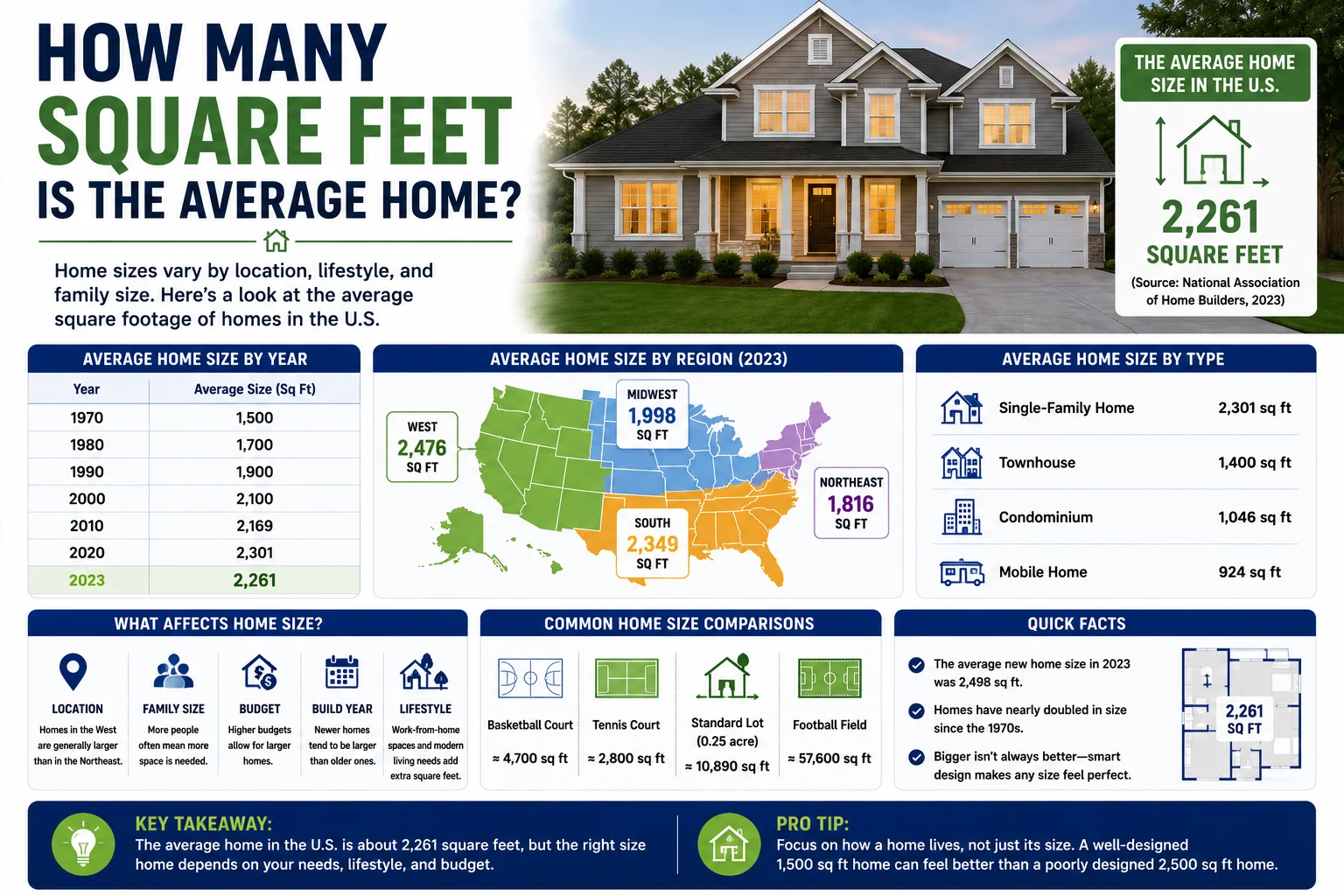
If you’re buying a house, building a new one, or simply curious about residential property sizes, you may wonder how many square feet is the average home. The answer depends on the country, the type of home, and when it was built. However, in many parts of the world—especially the United States—the average newly built single-family home is around 2,300 to 2,500 square feet, while older homes tend to be smaller.
Understanding average home sizes helps you compare properties, estimate construction costs, plan renovations, and decide how much living space your family actually needs. In this guide, we’ll explore average home sizes by country, bedroom count, and lifestyle, along with practical tips for choosing the right size home.
Quick Answer
The average home size varies by location, but here are some common figures:
| Country | Average Home Size |
|---|---|
| United States | 2,300–2,500 sq ft |
| Canada | 1,800–2,000 sq ft |
| Australia | 2,000–2,300 sq ft |
| United Kingdom | 800–1,000 sq ft |
| Many European Countries | 900–1,300 sq ft |
In the United States, the average existing single-family home is generally around 2,000–2,300 square feet, while newly constructed homes are often larger.
Average Home Size Around the World
United States
American homes are among the largest in the world. A typical new single-family house offers between 2,300 and 2,500 square feet of living space, often including three or four bedrooms, multiple bathrooms, and a garage.
Canada
Canadian homes average around 1,800 to 2,000 square feet, with detached homes generally being larger than townhouses or condominiums.
United Kingdom
Homes in the UK are considerably smaller, averaging 800 to 1,000 square feet. Higher population density and limited land contribute to more compact homes.
Australia
Australian homes are known for generous layouts, averaging 2,000 to 2,300 square feet, especially in suburban areas.
Europe
Across Europe, average home sizes typically range from 900 to 1,300 square feet, though this varies significantly by country and urban density.
Average Home Size by Number of Bedrooms
The number of bedrooms often determines the overall size of a house.
| Bedrooms | Average Size |
|---|---|
| 1 Bedroom | 600–900 sq ft |
| 2 Bedrooms | 800–1,200 sq ft |
| 3 Bedrooms | 1,200–1,800 sq ft |
| 4 Bedrooms | 1,800–2,500 sq ft |
| 5+ Bedrooms | 2,500–4,000+ sq ft |
These ranges vary depending on the home’s layout and whether it’s an apartment, townhouse, or detached house.
Home Size Comparison Chart
| Home Type | Typical Size |
|---|---|
| Studio Apartment | 400–600 sq ft |
| One-Bedroom Apartment | 600–900 sq ft |
| Small House | 800–1,200 sq ft |
| Average Family Home | 1,800–2,400 sq ft |
| Large Family Home | 2,500–3,500 sq ft |
| Luxury Home | 4,000+ sq ft |
What Is Considered Small, Average, and Large?
Small Home
A home under 1,200 square feet is generally considered small. These homes are easier to maintain and often cost less to heat and cool.
Average Home
Most family homes between 1,800 and 2,400 square feet fall into the average range, offering a balance of comfort and affordability.
Large Home
Homes exceeding 2,500 square feet typically include extra bedrooms, larger kitchens, home offices, recreation rooms, or additional storage.
How to Calculate a Home’s Square Footage
Calculating square footage is straightforward.
Multiply the length by the width of each room:
Length × Width = Square Feet
For example:
- Living room: 20 ft × 15 ft = 300 sq ft
- Kitchen: 12 ft × 10 ft = 120 sq ft
- Bedroom: 14 ft × 12 ft = 168 sq ft
Add the square footage of all finished rooms to determine the home’s total living area.
Factors That Affect Home Size
Several factors influence how large a home is.
Family Size
Larger families typically require more bedrooms, bathrooms, and shared living space.
Budget
Construction, purchase price, utilities, and maintenance costs all increase with home size.
Location
Urban homes tend to be smaller because land is more expensive, while suburban and rural homes often have more space.
Lifestyle
People who work from home or entertain guests frequently may prefer larger homes with dedicated offices or recreation areas.
Choosing the Right Home Size
The best home isn’t necessarily the biggest—it’s the one that meets your needs.
Consider:
- Number of occupants
- Future family plans
- Storage requirements
- Maintenance costs
- Energy efficiency
- Available budget
- Neighborhood and lot size
Buying more space than you need can increase ongoing expenses, while choosing a home that’s too small may limit comfort over time.
Common Mistakes When Comparing Home Sizes
Avoid these common errors:
- Comparing total area instead of usable living space
- Ignoring the home’s layout
- Overlooking storage and garage space
- Assuming larger homes are always better
- Forgetting future maintenance costs
- Not considering energy bills
A well-designed 1,800-square-foot home may feel more spacious than a poorly designed 2,300-square-foot house.
Expert Tips
- Focus on layout, not just square footage.
- Visit homes in person whenever possible.
- Think about your future needs before buying.
- Leave room in your budget for maintenance and utilities.
- Compare homes with similar layouts for a fair assessment.
- Consider resale value when choosing home size.
- Measure your furniture to ensure it fits comfortably.
FAQs
1. How many square feet is the average American home?
The average newly built American home is approximately 2,300 to 2,500 square feet, while older homes are often smaller.
2. Is a 2,000-square-foot house considered large?
For many families, 2,000 square feet is considered an average to moderately large home, offering enough space for three to four bedrooms.
3. What size house is best for a family of four?
A home between 1,800 and 2,400 square feet is generally comfortable for a family of four, depending on the layout.
4. Are newer homes larger than older homes?
Yes. In many countries, newly built homes are larger on average than homes constructed several decades ago.
5. Does square footage include the garage?
Typically, finished living space counts toward a home’s square footage, while garages, unfinished basements, and unfinished attics are usually excluded.
Conclusion
Understanding how many square feet is the average home helps you make informed decisions whether you’re buying, building, or comparing properties. While the average home size varies by country and region, many modern single-family homes range from 2,000 to 2,500 square feet, providing comfortable living space for most families.
When evaluating a home, remember that square footage is only one factor. A practical layout, efficient design, and features that match your lifestyle are often more important than simply having more space. By considering your family’s needs, budget, and long-term plans, you can choose a home that offers both comfort and value.