
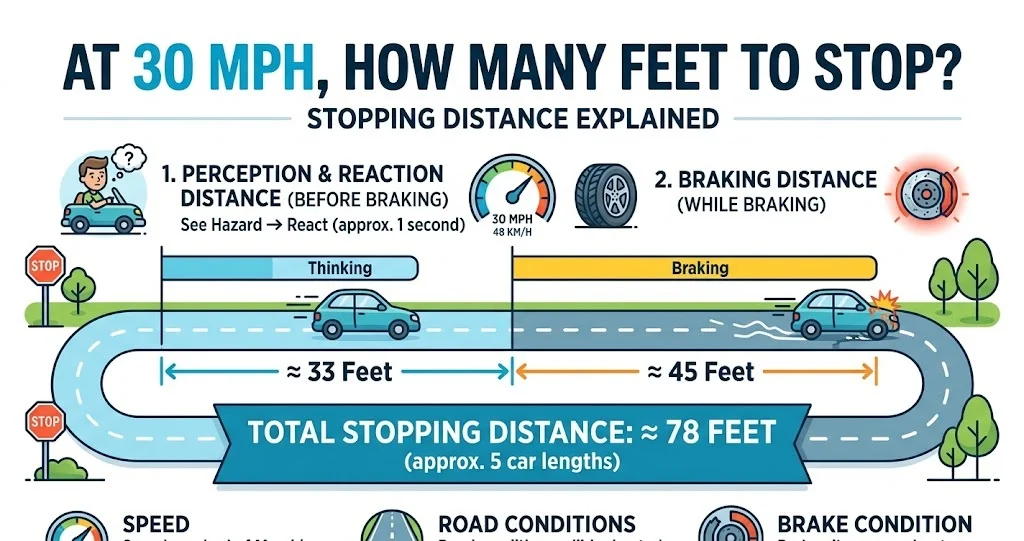
If you are asking at 30 mph how many feet to stop, the answer depends on two key parts:
- Reaction distance (how far the car travels before you hit the brakes)
- Braking distance (how far the car travels while stopping)
When combined, they form the total stopping distance.
Quick Answer
At 30 mph, a typical car needs:
About 75 to 120 feet to come to a complete stop on dry pavement.
Breakdown:
- Reaction distance: ~44 feet
- Braking distance: ~30–80 feet
- Total: ~75–120 feet
This varies based on road conditions, tires, and driver reaction time.
Understanding Stopping Distance
Stopping distance is made up of two parts:
Total Stopping Distance=Reaction Distance+Braking Distance
Even before you press the brake, your vehicle is still moving forward during reaction time.
Reaction Distance at 30 MPH
Human reaction time is typically around 1.5 seconds for an alert driver.
At 30 mph:
30 mph≈44 feet per second
So in 1.5 seconds:
44×1.5=66 feet
However, many driving safety charts use a slightly lower estimate for average alert driving conditions, often around 40–50 feet.
Braking Distance at 30 MPH
Braking distance depends on:
- Road surface
- Tire condition
- Vehicle weight
- Brake system
On dry pavement:
302=900 (speed squared factor for braking estimation)
Using standard driving physics approximations, this results in:
- ~30 to 80 feet braking distance at 30 mph
Total Stopping Distance
Combining both parts:
- Reaction distance: ~40–66 feet
- Braking distance: ~30–80 feet
Final range:
75 to 120 feet total stopping distance at 30 mph
Wet vs Dry Road Conditions
Dry Road
- Best traction
- Shortest stopping distance
- ~75–120 feet total
Wet Road
- Reduced traction
- Distance increases by 25%–50%
Ice or Snow
- Extremely long stopping distances
- Can be 2–10 times longer
Real-World Driving Examples
City Driving (30 MPH Zone)
If a car ahead suddenly stops:
- You may travel the length of 2–3 school buses before stopping
Residential Area
- Children or pets can appear within your stopping range
- Requires extra caution
Stopping Distance Chart (Approximate)
| Speed | Total Stopping Distance |
|---|---|
| 20 mph | 40–60 feet |
| 30 mph | 75–120 feet |
| 40 mph | 115–180 feet |
| 50 mph | 160–250 feet |
Common Mistakes Drivers Make
Following Too Closely
Many drivers leave less than 2 seconds of space.
Underestimating Speed Impact
Stopping distance increases dramatically with speed.
Ignoring Road Conditions
Wet roads significantly increase stopping distance.
Delayed Reaction
Distractions add precious seconds.
Expert Safety Tips
Use the 3-Second Rule
Maintain at least 3 seconds of following distance.
Increase Distance in Bad Weather
Double your normal following distance in rain.
Keep Tires Properly Inflated
Improves braking efficiency.
Avoid Distractions
Phones increase reaction time dramatically.
FAQs
1. At 30 mph how many feet to stop?
About 75 to 120 feet on dry roads.
2. What affects stopping distance the most?
Speed and road conditions have the biggest impact.
3. Does braking distance increase with speed?
Yes, it increases exponentially, not linearly.
4. How far do you travel in 1 second at 30 mph?
About 44 feet.
5. Is stopping distance longer in rain?
Yes, it can increase by 25% to 50%.
Conclusion
So, at 30 mph how many feet to stop?
A typical car needs about 75 to 120 feet to come to a complete stop at 30 mph, depending on reaction time and road conditions.
Understanding stopping distance is essential for safe driving. Even at moderate city speeds, a vehicle travels much farther than most people expect before fully stopping, making awareness and safe following distance critical.