

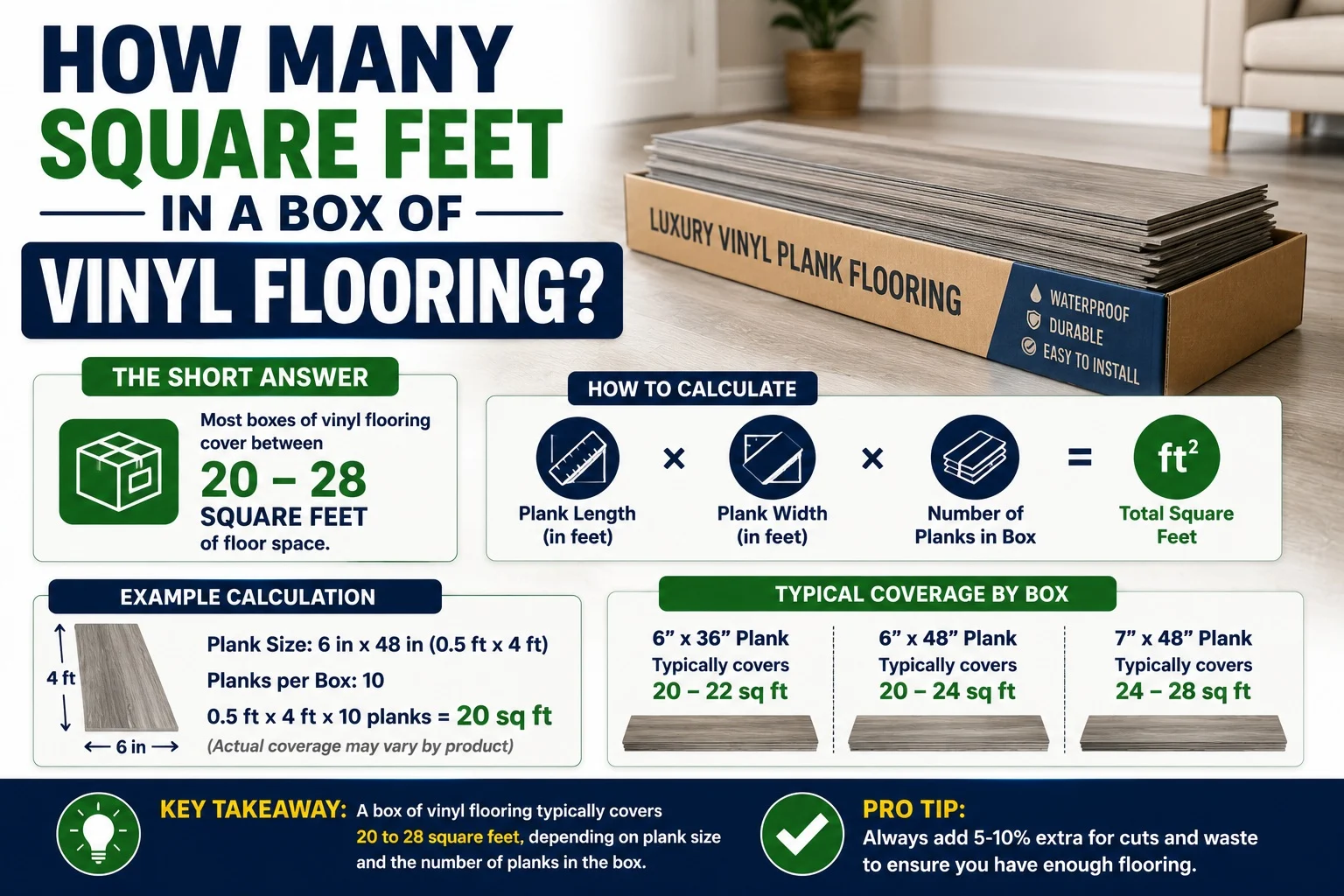
When planning a flooring project, one of the most common questions homeowners and contractors ask is:
How many square feet are in a box of vinyl flooring?
The answer is not a single fixed number because vinyl flooring comes in different formats such as planks, tiles, and sheets, and each manufacturer packages their product differently. However, most boxes of vinyl flooring cover a predictable range that makes estimating relatively easy.
In this guide, you’ll learn how many square feet are typically in a box of vinyl flooring, how to calculate coverage accurately, how much extra material to buy, and what factors affect total square footage per box.
Quick Answer
Most boxes of vinyl flooring cover:
20 to 40 square feet per box
In general:
Average vinyl flooring box coverage ≈22 to 30 sq ft
However, premium or large plank vinyl can cover up to:
40 to 50 square feet per box
So the exact answer depends on the product type.
Why Vinyl Flooring Coverage Varies
Unlike standardized units like square feet or square yards, vinyl flooring is sold by:
- Brand
- Thickness
- Plank size
- Tile dimensions
- Installation type (click-lock, glue-down, peel-and-stick)
Each of these factors affects how many planks fit in a box.
Types of Vinyl Flooring and Their Coverage
1. Vinyl Plank Flooring (LVP)
Luxury Vinyl Plank is the most common type.
Typical coverage per box:
20 to 28 square feet per box
Used for:
- Living rooms
- Bedrooms
- Hallways
- Kitchens
2. Vinyl Tile Flooring (LVT)
Luxury Vinyl Tile comes in square tile formats.
Typical coverage:
10 to 40 square feet per box
depending on tile size and thickness.
3. Sheet Vinyl Flooring
Sheet vinyl is sold in large rolls, not boxes.
Coverage depends on roll size:
- Often sold per square yard
- Typically covers large continuous areas
Standard Box Coverage Examples
Here are real-world examples of vinyl flooring box coverage:
Example 1: Standard Vinyl Plank Box
22.5 sq ft per box
This is one of the most common sizes in home improvement stores.
Example 2: Wide Plank Vinyl Box
28.8 sq ft per box
Used in premium flooring collections.
Example 3: Budget Vinyl Tile Box
12 to 18 sq ft per box
Typically smaller tiles or peel-and-stick options.
How to Calculate Square Feet Needed
To determine how many boxes you need, first measure your room.
Step 1: Measure Room Dimensions
Use:
Length×Width
Example room:
- 12 ft × 15 ft
Calculation:
12×15=180 sq ft
Step 2: Divide by Box Coverage
If each box covers:
22.5 sq ft
Then:
180÷22.5=8 boxes
So you would need about 8 boxes.
Always Add Waste Factor
When installing vinyl flooring, you should account for waste due to:
- Cutting
- Pattern matching
- Mistakes
- Room edges
Standard waste factor:
_prefetch_v2″:{“content”:”5\%\text{ to }10\%”}}
Example With Waste
Room size:
180 sq ft
Add 10% waste:
180×1.10=198 sq ft
Now calculate boxes:
198÷22.5≈8.8
So you would buy:
9 boxes
What Affects Square Feet Per Box?
Several factors determine how much coverage a box provides.
1. Plank Size
Larger planks = fewer pieces per box but often similar coverage.
2. Thickness
Thicker planks may be heavier, reducing quantity per box.
3. Brand Design
Different manufacturers use different packaging standards.
4. Installation Type
- Click-lock systems may include fewer pieces
- Glue-down tiles may be more densely packed
5. Decorative Layering
Some premium flooring includes thicker wear layers.
Typical Room Coverage Examples
Here’s how many boxes you might need for common rooms.
Small Bedroom (100 sq ft)
100÷22.5≈4.4 boxes
→ about 5 boxes
Medium Bedroom (150 sq ft)
150÷22.5≈6.7 boxes
→ about 7 boxes
Living Room (300 sq ft)
300÷22.5≈13.3 boxes
→ about 14 boxes
Vinyl Flooring Coverage Comparison Table
| Box Type | Coverage |
|---|---|
| Small tile vinyl | 10–18 sq ft |
| Standard plank vinyl | 20–28 sq ft |
| Premium wide plank | 28–40 sq ft |
| High-end luxury vinyl | 40+ sq ft |
Why Manufacturers Don’t Standardize Box Sizes
Vinyl flooring is not regulated to a single box size because:
- Different styles require different plank sizes
- Manufacturing efficiency varies
- Design collections change frequently
- Market competition encourages variety
How to Read a Flooring Box Label
Every box includes key information:
- Total square feet per box
- Number of planks or tiles
- Plank dimensions
- Wear layer thickness
Always check:
“Coverage per box (sq ft)”
before buying.
Common Mistakes When Buying Vinyl Flooring
1. Not Adding Waste
Leads to shortage during installation.
2. Ignoring Box Coverage Differences
Two similar-looking products may have different coverage.
3. Measuring Room Incorrectly
Always measure multiple times.
4. Forgetting Doorways and Closets
These still require flooring material.
Tips for Buying the Right Amount
Measure Twice
Accuracy prevents overbuying or shortages.
Buy Extra Boxes
Always keep at least one extra box for repairs.
Match Batch Numbers
Color variations can occur between production batches.
Check Return Policy
Some stores allow returns of unopened boxes.
FAQs
How many square feet are in a box of vinyl flooring?
Typically:
20 to 40 square feet per box
How many boxes do I need for 200 sq ft?
200÷22.5≈8.9
So about 9–10 boxes
Does all vinyl flooring cover the same area per box?
No.
Coverage varies by product and manufacturer.
Is vinyl flooring sold by square foot or box?
Most retail vinyl flooring is sold:
By the box
Conclusion
So, how many square feet are in a box of vinyl flooring?
The answer is:
Most vinyl flooring boxes cover 20 to 40 square feet, with the average being around 22 to 30 square feet per box.
The exact amount depends on plank size, brand, and flooring type, so always check the product label before purchasing. By accurately measuring your space and accounting for waste, you can confidently calculate how many boxes you need and avoid costly shortages during installation.