

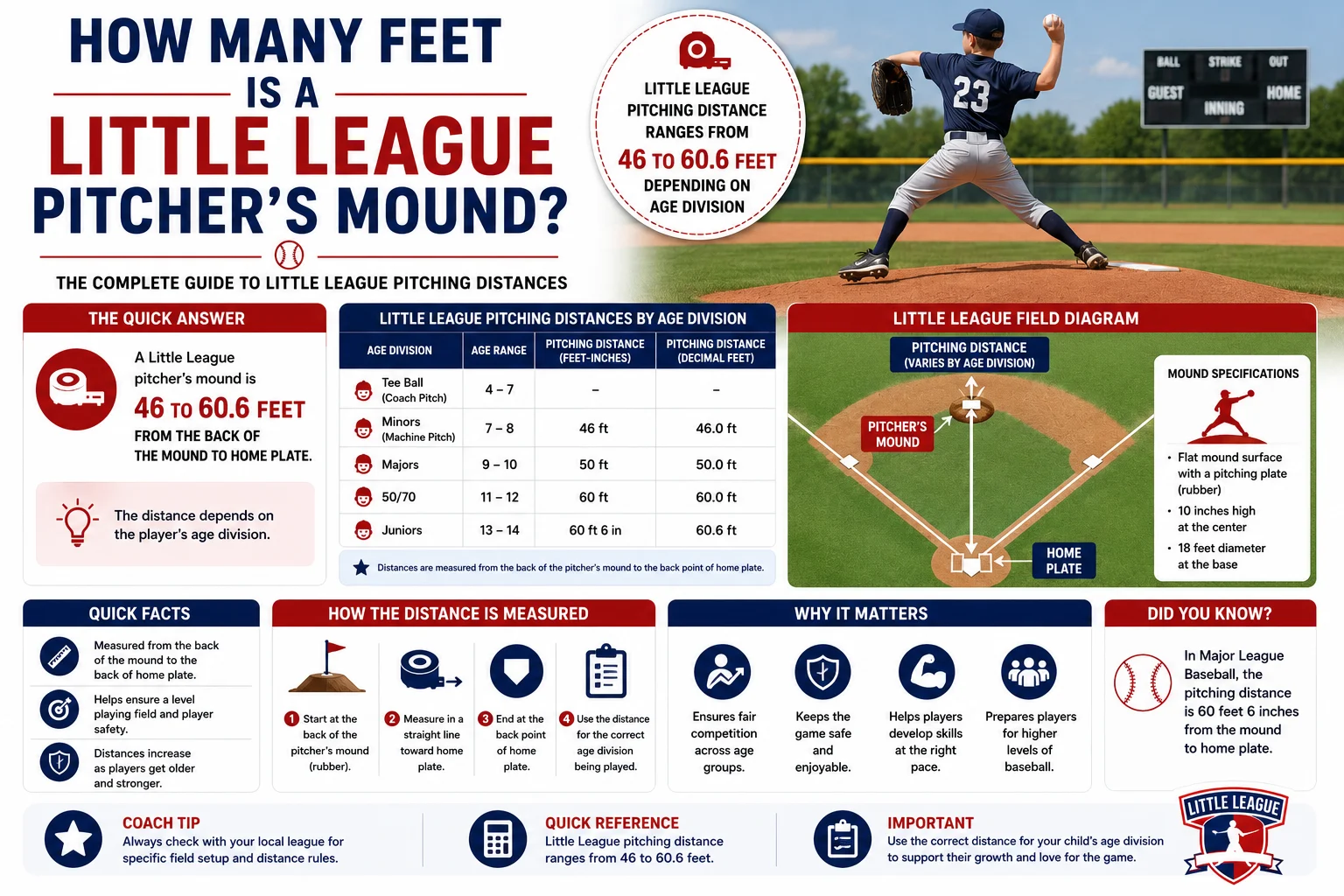
If you’re setting up a baseball field or coaching young players, you may wonder, how many feet is a Little League pitcher’s mound? For most Little League divisions, the pitching rubber is 46 feet from home plate.
This distance is shorter than the mound used in professional baseball because younger players are still developing their strength, control, and pitching mechanics.
The official distance can vary depending on the age division, but the standard Little League baseball mound for players ages 9–12 is:
- 46 feet from the pitching rubber to the back point of home plate.
- 60 feet between bases.
Understanding these measurements helps coaches, parents, and players create a safe and enjoyable playing environment.
Quick Answer
The standard Little League pitching distance is:
| Division | Pitching Distance |
|---|---|
| Tee Ball | No official mound |
| Minor League | 46 feet |
| Little League (Majors) | 46 feet |
| Intermediate (50/70) | 50 feet |
| Junior League | 54 feet |
| Senior League | 60 feet 6 inches |
For most Little League players, the mound sits 46 feet from home plate.
Official Little League Pitching Distance
Little League Baseball divides players into several age groups. Each division uses different field dimensions to match players’ abilities.
For the standard Little League division, which usually includes players aged 9–12:
- Pitching distance: 46 feet
- Base paths: 60 feet
- Mound height: approximately 6 inches above home plate
These measurements are designed to balance offense and defense while helping young pitchers develop proper skills.
Little League Field Dimensions by Age Group
As players grow older, the field becomes larger.
| Division | Ages | Pitching Distance | Base Distance |
|---|---|---|---|
| Tee Ball | 4–7 | Varies | 50–60 ft |
| Coach Pitch | 5–8 | Varies | 60 ft |
| Minor League | 7–11 | 46 ft | 60 ft |
| Little League Majors | 9–12 | 46 ft | 60 ft |
| Intermediate (50/70) | 11–13 | 50 ft | 70 ft |
| Junior League | 12–14 | 54 ft | 80 ft |
| Senior League | 13–16 | 60 ft 6 in | 90 ft |
Each step prepares players for larger fields and more competitive play.
How Is the Pitching Distance Measured?
Many people assume the distance is measured from the center of the mound, but the official measurement begins at the pitching rubber.
The measurement runs:
- From the front edge of the pitching rubber
- To the back point of home plate
The mound itself is larger than the pitching distance.
Little League vs. Major League Pitching Distance
Professional baseball uses much larger dimensions than Little League.
| Field Type | Pitching Distance |
|---|---|
| Little League | 46 ft |
| Intermediate (50/70) | 50 ft |
| Junior League | 54 ft |
| Major League Baseball | 60 ft 6 in |
Major League pitchers throw from a distance that is 14 feet 6 inches farther than standard Little League pitchers.
Why Does Pitching Distance Change With Age?
The pitching distance increases as players get older for several reasons.
Player Strength
Older players throw harder and need more room.
Skill Development
Longer distances encourage better pitching mechanics and accuracy.
Safety
Shorter distances help younger players react more quickly.
Fair Competition
Field dimensions are adjusted to keep games balanced and enjoyable.
Other Important Little League Field Measurements
The pitching mound is only one part of the field.
Here are several other important measurements.
| Feature | Distance |
|---|---|
| Home plate to first base | 60 ft |
| Home plate to second base | 84 ft 10 in |
| Home plate to third base | 60 ft |
| Pitching rubber to home plate | 46 ft |
Outfield fences also vary depending on league rules.
Little League Mound Dimensions
The mound itself has specific dimensions.
Typical measurements include:
- Diameter: approximately 10 feet
- Height: around 6 inches
- Pitching rubber width: 24 inches
The slope of the mound must also meet league guidelines.
Tips for Building a Little League Field
If you are setting up a field, keep these tips in mind:
- Measure carefully.
- Use official league guidelines.
- Check mound height.
- Mark base paths accurately.
- Maintain the pitching rubber.
Proper field dimensions help create a safer and more enjoyable game.
Common Mistakes to Avoid
Avoid these common errors when measuring a Little League field:
- Measuring from the center of the mound instead of the rubber.
- Using Major League dimensions.
- Forgetting to verify age-group rules.
- Ignoring mound height requirements.
Double-checking measurements can prevent costly mistakes.
Fun Facts About Little League Baseball
- Little League Baseball was founded in 1939.
- Millions of children play Little League around the world.
- The Little League World Series attracts teams from many countries.
- Players transition through several field sizes as they grow.
FAQs
How far is a Little League pitcher’s mound from home plate?
For most Little League divisions, the pitching rubber is 46 feet from home plate.
Is the Little League mound the same as an MLB mound?
No. Major League Baseball uses a pitching distance of 60 feet 6 inches.
What age group uses a 46-foot mound?
Players in the standard Little League division, typically ages 9–12, use a 46-foot pitching distance.
How high is a Little League pitcher’s mound?
A Little League mound is generally about 6 inches high.
How wide is the pitching rubber?
The pitching rubber in Little League is 24 inches wide.
Conclusion
Now you know the answer to “how many feet is a Little League pitcher’s mound?” For most Little League players, the official pitching distance is 46 feet from home plate.
Whether you’re coaching a team, building a field, or helping a young athlete practice, using the correct dimensions ensures fair play and proper skill development. Check your league’s rules to confirm measurements for your specific age division.