

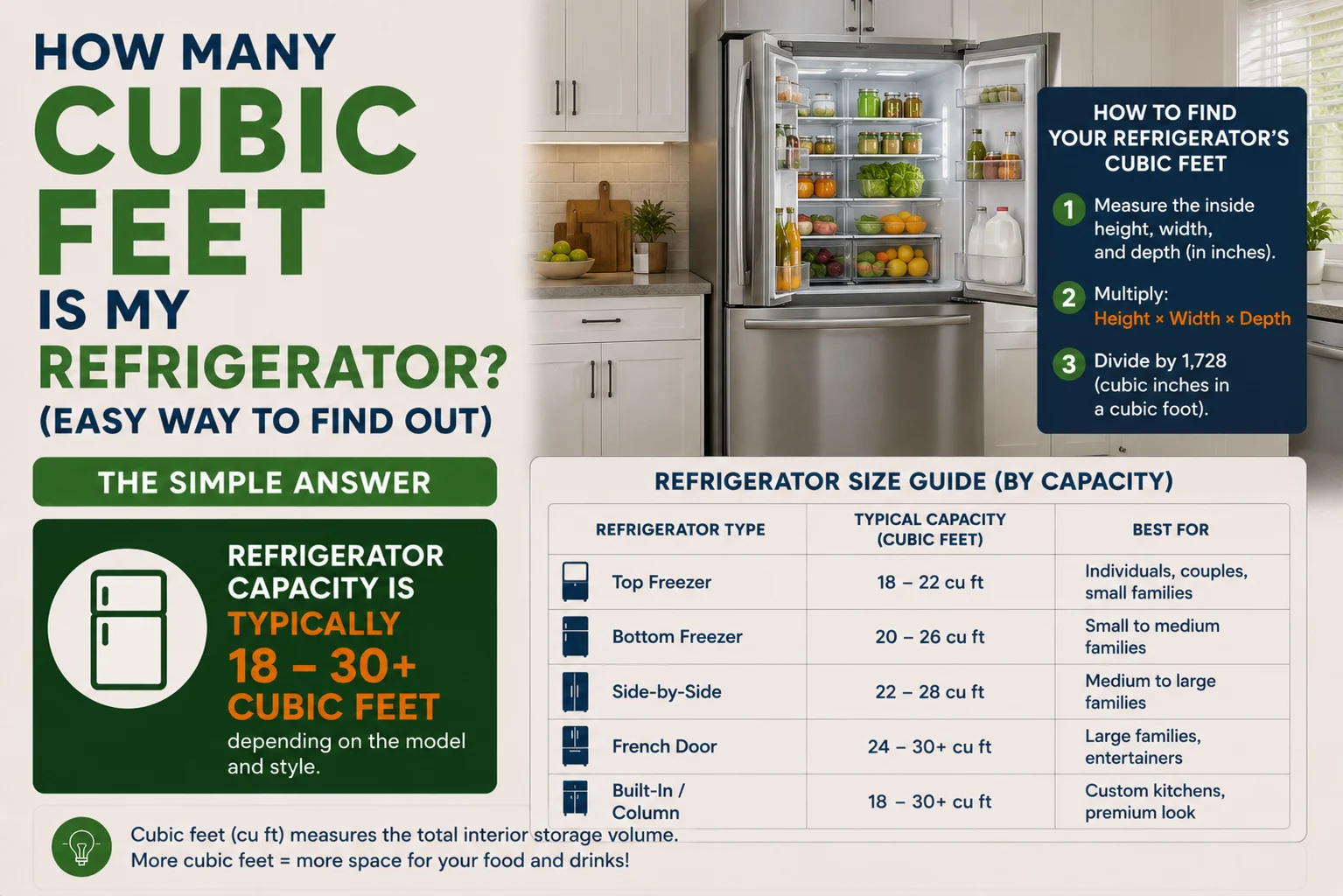
If you’re asking “how many cubic feet is my refrigerator”, the truth is simple: it depends on your exact model. Refrigerator size is not universal, and two fridges that look similar can have very different internal capacity.
Most home refrigerators fall into a predictable range, and you can also calculate or find your exact number in minutes.
Quick Answer (Most Common Refrigerator Sizes)
Most household refrigerators are:
- Small fridges: 10–18 cubic feet
- Standard fridges: 18–22 cubic feet
- Large fridges: 22–30+ cubic feet
18 \text{ to } 22\ \text{cubic feet (typical household refrigerator range)
👉 So if you don’t know your exact model, chances are your refrigerator is around 20–22 cubic feet.
How to Find Your Exact Refrigerator Size
There are 3 reliable ways to figure out how many cubic feet your refrigerator is:
1. Check the Manufacturer Label (Best Method)
Look for a sticker inside the fridge:
- Inside door frame
- Wall of the fresh food compartment
- Behind crisper drawers
It usually says something like:
- “Total capacity: 21.6 cu. ft.”
This is the most accurate measurement.
2. Check the Model Number Online
If you find your model number:
- Search: “[model number] refrigerator specs”
- Look for “total capacity” or “storage volume”
This is how appliance stores and repair techs confirm size.
3. Measure It Yourself (If Label Is Missing)
You can estimate using interior dimensions:
Volume=Height×Width×Depth
Step-by-step:
- Measure inside height (feet)
- Measure width (feet)
- Measure depth (feet)
- Multiply all three numbers
Example:
If your fridge interior is:
- Height = 5.5 ft
- Width = 2.5 ft
- Depth = 2 ft
5.5×2.5×2=27.5 cubic feet
👉 That fridge would be about 27.5 cubic feet
What Refrigerator Size Feels Like in Real Life
Here’s how cubic feet translates into actual storage:
10–15 cubic feet
- Small apartment fridge
- Limited freezer space
- 1 person household
16–22 cubic feet (Most common)
- Family of 2–4 people
- Weekly groceries
- Balanced fridge/freezer space
23–30+ cubic feet
- Large families
- Bulk shopping
- French door or side-by-side models
Why Refrigerator Size Matters
Knowing how many cubic feet your refrigerator is helps you:
- Plan grocery storage
- Avoid overcrowding
- Choose the right replacement fridge
- Improve energy efficiency
- Organize food better
Common Mistakes People Make
1. Confusing external size with capacity
A big-looking fridge doesn’t always mean more cubic feet inside.
2. Ignoring freezer space
Total cubic feet includes both:
- Refrigerator section
- Freezer section
3. Assuming all “standard” fridges are the same
Standard can still vary from 18 to 26 cubic feet.
Quick Reference Table
| Fridge Type | Typical Size |
|---|---|
| Mini fridge | 1.7 – 4.5 cu ft |
| Apartment fridge | 10 – 18 cu ft |
| Standard home fridge | 18 – 22 cu ft |
| Large family fridge | 22 – 30+ cu ft |
Expert Tip
If you’re unsure and can’t find the label:
👉 Assume your fridge is around 20 cubic feet, because that is the most common residential size worldwide.
Conclusion
So, how many cubic feet is my refrigerator?
Most likely, it falls between 18 and 22 cubic feet, with the average home refrigerator being about 20 cubic feet.
The exact number depends on your model, but you can confirm it easily by checking the manufacturer label, looking up the model number, or measuring the interior volume yourself.
If you want, tell me your fridge model number and I can calculate the exact cubic feet for you.