

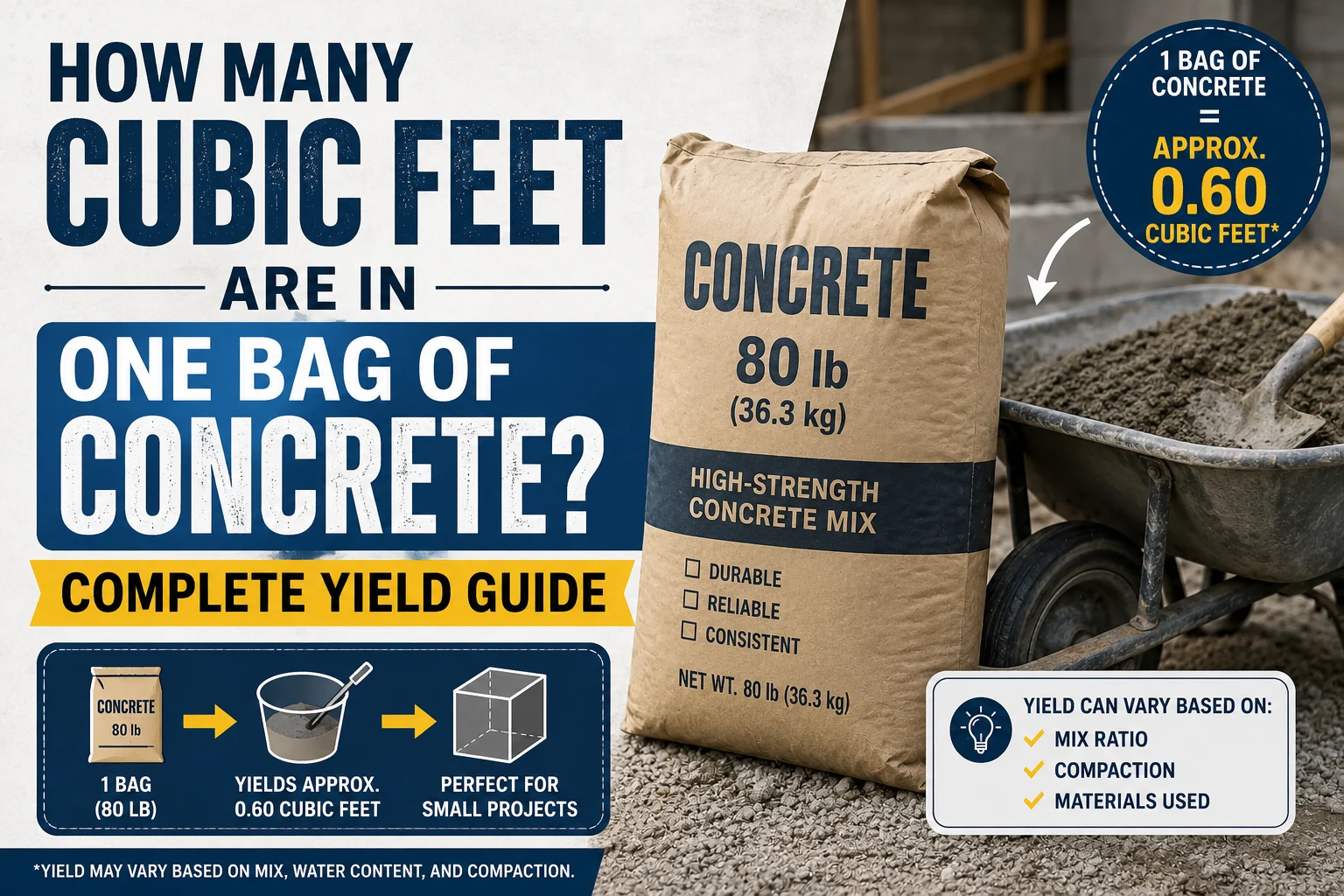
If you’re planning a concrete project, one of the first questions you’ll likely ask is:
How many cubic feet are in one bag of concrete?
The answer depends on the weight of the bag. Concrete mix is sold in several standard bag sizes, and each produces a different volume of finished concrete when mixed with water.
Knowing the yield of each bag helps you:
- Estimate how many bags you’ll need
- Avoid buying too much or too little concrete
- Calculate project costs accurately
- Reduce material waste
In this guide, you’ll learn the cubic-foot yield for every common bag size, how to calculate the number of bags needed, and practical examples for patios, fence posts, sidewalks, and slabs.
How Many Cubic Feet Are in One Bag of Concrete?
The amount of concrete produced depends on the bag size.
Standard Concrete Bag Yield
| Bag Size | Approximate Yield |
|---|---|
| 40 lb | 0.30 cubic feet |
| 50 lb | 0.375 cubic feet |
| 60 lb | 0.45 cubic feet |
| 80 lb | 0.60 cubic feet |
| 90 lb | 0.675 cubic feet |
✔ An 80-pound bag—the most common size—produces approximately 0.60 cubic feet of concrete.
Concrete Bag Sizes Explained
Concrete mix is sold by weight, not by volume.
The finished volume depends on:
- Bag weight
- Aggregate size
- Cement composition
- Water added during mixing
The manufacturer’s stated yield is the best estimate for planning.
Common Concrete Bag Sizes
40-Pound Bag
Produces approximately:
0.30 cubic feet
Best for:
- Small repairs
- Fence posts
- Mailbox posts
- Minor patching
50-Pound Bag
Produces approximately:
0.375 cubic feet
Ideal for:
- Small slabs
- Garden projects
- Walkway repairs
60-Pound Bag
Produces approximately:
0.45 cubic feet
Commonly used for:
- Deck footings
- Sidewalk repairs
- Steps
80-Pound Bag
Produces approximately:
0.60 cubic feet
This is the most popular size because it offers:
- Better value
- Fewer bags needed
- Efficient mixing
Suitable for:
- Patios
- Driveways
- Slabs
- Footings
90-Pound Bag
Produces approximately:
0.675 cubic feet
Often used for:
- Large commercial jobs
- Foundations
- Heavy-duty construction
What Is a Cubic Foot?
A cubic foot measures volume, not area.
One cubic foot equals:
- 12 inches × 12 inches × 12 inches
- 1,728 cubic inches
Concrete volume is always measured in cubic feet or cubic yards.
Formula for Calculating Concrete Volume
To determine how much concrete you need, use:
Volume = Length × Width × Thickness
For measurements in feet:
- Length (ft)
- Width (ft)
- Thickness (ft)
The result is the required cubic feet of concrete.
Example Calculation
Suppose you’re pouring a slab that measures:
- Length = 8 feet
- Width = 4 feet
- Thickness = 4 inches
Convert thickness:
4 inches ÷ 12 = 0.333 feet
Now calculate:
8 × 4 × 0.333 = 10.66 cubic feet
If using 80-pound bags:
10.66 ÷ 0.60 = 17.8
Round up:
You’ll need 18 bags.
How Many Bags Make One Cubic Foot?
| Bag Size | Bags per Cubic Foot |
|---|---|
| 40 lb | 3.33 bags |
| 50 lb | 2.67 bags |
| 60 lb | 2.22 bags |
| 80 lb | 1.67 bags |
| 90 lb | 1.48 bags |
How Many Bags Make One Cubic Yard?
One cubic yard equals:
27 cubic feet
Approximate bags required:
| Bag Size | Bags per Cubic Yard |
|---|---|
| 40 lb | 90 bags |
| 50 lb | 72 bags |
| 60 lb | 60 bags |
| 80 lb | 45 bags |
| 90 lb | 40 bags |
Common Concrete Projects
Fence Posts
Most fence posts require:
- 1–2 bags of 80-pound concrete
depending on hole size.
Mailbox Posts
Usually require:
- One 50- or 60-pound bag
Sidewalk Sections
Often require:
- Multiple 80-pound bags depending on dimensions.
Patios
A small patio may require:
- 40–80 bags
depending on thickness.
Concrete Slabs
Garage and shed slabs often require dozens of bags or ready-mix concrete.
Coverage Examples
One 80-lb Bag
Produces:
0.60 cubic feet
Can cover approximately:
- 2 square feet at 4 inches thick
Five 80-lb Bags
Yield:
5 × 0.60 = 3 cubic feet
Ten 80-lb Bags
Yield:
10 × 0.60 = 6 cubic feet
Twenty 80-lb Bags
Yield:
20 × 0.60 = 12 cubic feet
Tips for Buying Concrete
Buy Extra
Purchase about 5–10% more concrete than your calculated requirement to account for spills, uneven ground, or slight variations in mixing.
Use the Same Brand
Mixing different brands may result in slight differences in color and strength.
Follow Water Instructions
Adding too much water can weaken the finished concrete.
Consider Ready-Mix
For large projects requiring more than about 1 cubic yard of concrete, ready-mix delivery may be more economical and less labor-intensive.
Common Mistakes
Confusing Bag Weight with Yield
An 80-pound bag does not produce 80 cubic feet.
It produces only about 0.60 cubic feet.
Forgetting Thickness
Always include slab thickness in your calculations.
Not Rounding Up
Concrete should always be rounded up to the next whole bag.
Ignoring Waste
Allow extra material for minor losses and uneven surfaces.
Frequently Asked Questions
How many cubic feet are in an 80-pound bag of concrete?
An 80-pound bag produces approximately 0.60 cubic feet of finished concrete.
How many cubic feet are in a 60-pound bag?
Approximately 0.45 cubic feet.
How many cubic feet are in a 50-pound bag?
Approximately 0.375 cubic feet.
How many cubic feet are in a 40-pound bag?
Approximately 0.30 cubic feet.
How many 80-pound bags make one cubic yard?
You’ll need approximately 45 bags.
Should I buy extra concrete?
Yes. It’s recommended to purchase 5–10% extra to account for waste and measurement variations.
Concrete Bag Yield Chart
| Bag Weight | Cubic Feet Produced |
|---|---|
| 40 lb | 0.30 cu ft |
| 50 lb | 0.375 cu ft |
| 60 lb | 0.45 cu ft |
| 80 lb | 0.60 cu ft |
| 90 lb | 0.675 cu ft |
Conclusion
The answer to “How many cubic feet are in one bag of concrete?” depends on the bag size.
Quick Reference
- 40 lb bag = 0.30 cubic feet
- 50 lb bag = 0.375 cubic feet
- 60 lb bag = 0.45 cubic feet
- 80 lb bag = 0.60 cubic feet
- 90 lb bag = 0.675 cubic feet
The 80-pound bag is the most commonly used for residential projects and yields approximately 0.60 cubic feet of concrete.
By understanding concrete bag yields and calculating your project’s total volume, you can purchase the right amount of material, reduce waste, and complete your project efficiently.