
Choosing the right air conditioner for a 600-square-foot space can make a major difference in comfort, energy use, and operating costs. If an AC is too small, it may run constantly without adequately cooling the room. If it’s too large, it can cycle on and off too frequently and may not remove humidity effectively.
So, how many BTUs for 600 square feet?
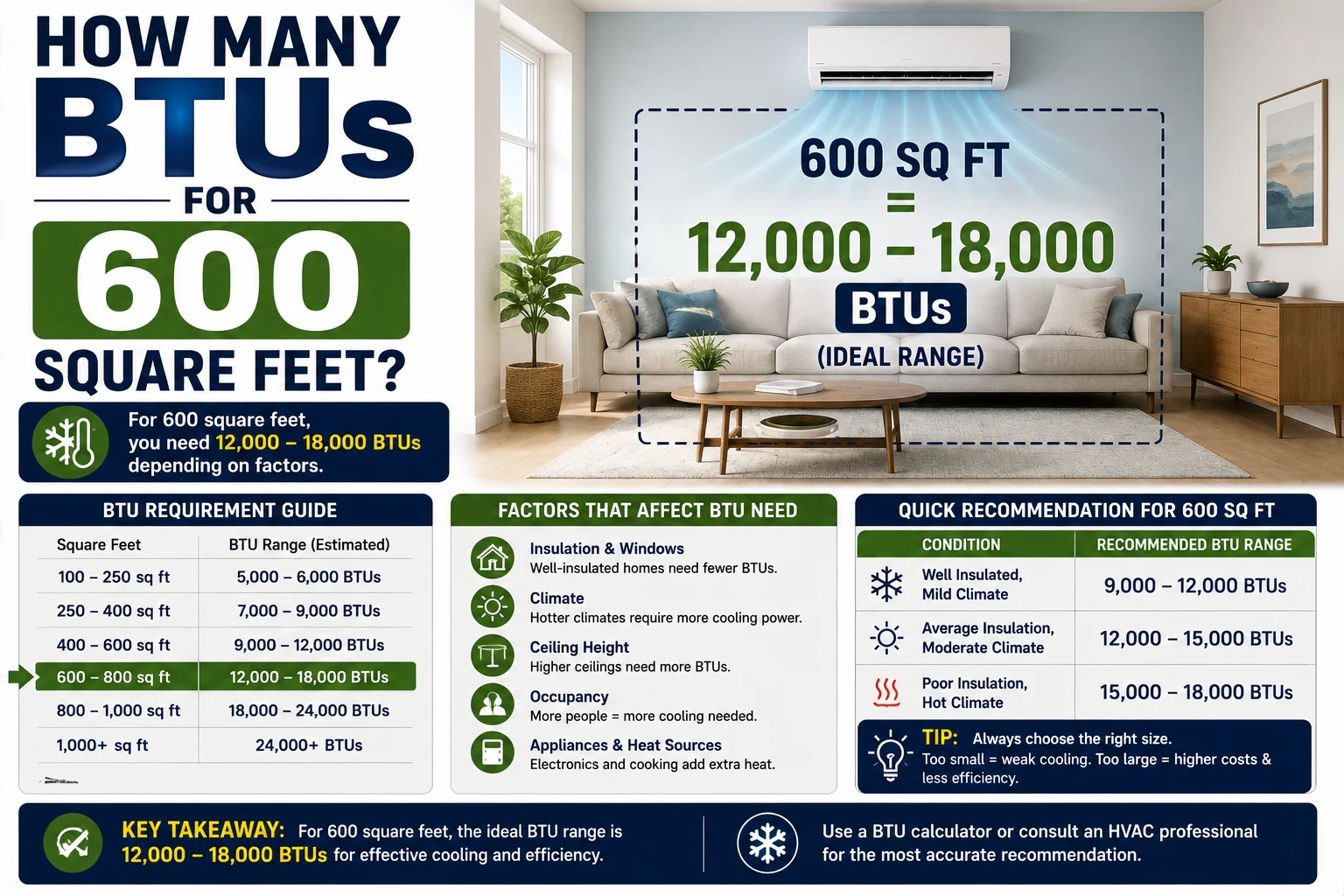
As a general starting point, a 600-square-foot space often needs around 12,000–14,000 BTUs of cooling capacity, but the ideal size depends on several factors.
For a relatively average space with standard ceilings, decent insulation, and moderate outdoor temperatures, 12,000 BTUs (1 ton) is a common starting point. A hotter climate, poor insulation, high ceilings, or significant sun exposure may increase the required capacity.
A=lw
A=6×4=24
4 rows by 6 columns = 24 square units.
w
w
l
l24 square unitsw = 6l = 4
Give feedback
The most important point is that square footage alone doesn’t determine the exact BTU requirement. Proper HVAC sizing considers the building’s cooling load, not just its floor area.
Quick Answer: How Many BTUs for 600 Square Feet?
For a typical 600-square-foot space:
Approximately 12,000–14,000 BTUs is a reasonable general range.
A basic guide is:
| Space | Approximate Cooling Capacity |
|---|---|
| 400 sq ft | 8,000–10,000 BTUs |
| 500 sq ft | 10,000–12,000 BTUs |
| 600 sq ft | 12,000–14,000 BTUs |
| 700 sq ft | 14,000–16,000 BTUs |
| 800 sq ft | 16,000–18,000 BTUs |
| 1,000 sq ft | 20,000–24,000 BTUs |
These are general estimates, not a substitute for a professional cooling-load calculation.
What Does BTU Mean?
BTU stands for British thermal unit.
In air conditioning, BTUs are commonly used to describe the amount of heat an air conditioner can remove from a space over a period of time.
The higher the BTU rating, the greater the cooling capacity.
For example:
- 8,000 BTUs = smaller cooling capacity
- 10,000 BTUs = moderate capacity
- 12,000 BTUs = approximately 1 ton of cooling
- 18,000 BTUs = approximately 1.5 tons
- 24,000 BTUs = approximately 2 tons
When you’re choosing an AC, the goal isn’t simply to select the largest available unit. You want a capacity that matches the actual cooling load of the space.
Is 12,000 BTUs Enough for 600 Square Feet?
In many situations, 12,000 BTUs can be suitable for 600 square feet.
It may work particularly well when the space has:
- Standard 8-foot ceilings
- Good insulation
- Moderate outdoor temperatures
- Energy-efficient windows
- Limited direct sunlight
- Average occupancy
- Few heat-producing appliances
However, 12,000 BTUs may not be enough for every 600-square-foot space.
A poorly insulated room in a very hot climate can require considerably more cooling capacity than a well-insulated room in a mild climate.
Is 14,000 BTUs Enough for 600 Square Feet?
A 14,000-BTU air conditioner can provide substantial cooling capacity for a 600-square-foot area.
It may be appropriate when the space has higher-than-average cooling requirements because of:
- Hot weather
- Direct afternoon sunlight
- Poor insulation
- Multiple occupants
- Large windows
- High ceilings
- Heat-generating appliances
However, bigger isn’t automatically better.
An oversized AC can cool the air quickly without running long enough to properly dehumidify the space. This can make the room feel damp even when the temperature appears comfortable.
How Many Tons of AC for 600 Square Feet?
One ton of air-conditioning capacity equals approximately:
12,000 BTUs
Therefore:
12,000 BTUs ÷ 12,000 = 1 ton
For a typical 600-square-foot space, around 1 ton of cooling capacity can be a reasonable starting point.
However, some 600-square-foot spaces may require more than 1 ton because of climate, insulation, ceiling height, windows, and other conditions.
600 Square Feet AC Size Chart
Here’s a general reference:
| Area | Approximate BTUs | Approximate AC Capacity |
|---|---|---|
| 300 sq ft | 6,000–7,000 | 0.5 ton |
| 400 sq ft | 8,000–10,000 | 0.67–0.83 ton |
| 500 sq ft | 10,000–12,000 | 0.83–1 ton |
| 600 sq ft | 12,000–14,000 | 1–1.17 tons |
| 700 sq ft | 14,000–16,000 | 1.17–1.33 tons |
| 800 sq ft | 16,000–18,000 | 1.33–1.5 tons |
| 900 sq ft | 18,000–21,000 | 1.5–1.75 tons |
| 1,000 sq ft | 20,000–24,000 | 1.67–2 tons |
Again, these numbers are general planning estimates.
How Climate Affects BTU Requirements
Climate is one of the most important factors in AC sizing.
A 600-square-foot room in a mild climate may require less cooling than an otherwise identical room in an extremely hot climate.
For example, a space with:
- Moderate temperatures
- Good insulation
- Limited sunlight
may work well with approximately 12,000 BTUs.
A similar space with:
- Extreme summer temperatures
- Poor insulation
- Large sun-facing windows
may need additional capacity.
This is why a single “BTU per square foot” number shouldn’t be treated as an exact rule for every location.
How Insulation Affects AC Size
Insulation helps slow the transfer of heat between the outside and inside of a building.
A well-insulated 600-square-foot space generally has a lower cooling load than a poorly insulated space.
Good insulation
May allow a smaller AC to maintain the desired temperature efficiently.
Poor insulation
Can allow heat to enter rapidly, increasing the cooling demand.
If your space gets hot quickly after the AC shuts off, insulation and air leakage may be part of the problem.
How Ceiling Height Affects BTU Requirements
Most basic square-foot estimates assume standard ceiling heights.
A room with an 8-foot ceiling has considerably less air volume than a room with a 12-foot ceiling covering the same floor area.
For example:
600 sq ft × 8 ft
= 4,800 cubic feet
600 sq ft × 12 ft
= 7,200 cubic feet
The second room contains significantly more air volume.
High ceilings can therefore affect the cooling requirement, particularly when the room is poorly insulated or has substantial heat gain.
How Sunlight Affects AC Sizing
Direct sunlight can significantly increase heat entering a room.
A 600-square-foot room with large south- or west-facing windows may require more cooling than a shaded room of the same size.
Factors that can reduce solar heat gain include:
- Window shades
- Curtains
- Exterior shading
- Energy-efficient windows
- Trees
- Window films
If a room receives strong afternoon sunlight, this should be considered when sizing the AC.
How Many People Affect BTU Requirements?
People generate heat.
A 600-square-foot room occupied by one or two people has a different cooling load from a space regularly occupied by a larger group.
This matters particularly for:
- Offices
- Small classrooms
- Meeting rooms
- Studios
- Shops
- Entertainment spaces
A space with unusually high occupancy may need additional cooling capacity.
Appliances Can Increase Cooling Requirements
Electrical equipment releases heat into a room.
Examples include:
- Computers
- Televisions
- Ovens
- Refrigerators
- Gaming systems
- Lighting
- Servers
A 600-square-foot kitchen, for example, may have a higher cooling load than a 600-square-foot bedroom because of cooking equipment and other heat-producing appliances.
How Many BTUs for a 600-Square-Foot Apartment?
A 600-square-foot apartment may require approximately 12,000–14,000 BTUs, depending on climate, insulation, windows, ceiling height, and layout.
An open-plan apartment may be easier to cool with a single appropriately sized unit.
If the apartment contains several separate rooms, one AC may not distribute air evenly throughout the entire space.
In that case, multiple units or a properly designed ducted system may provide better temperature control.
How Many BTUs for a 600-Square-Foot Room?
For a single 600-square-foot room, a general starting estimate is:
12,000 BTUs
But if the room has unusually high heat gain, approximately 14,000 BTUs or more may be considered depending on the circumstances.
The actual requirement should be based on the room’s cooling load.
How Many BTUs for a 600-Square-Foot Garage?
Garages can be harder to cool than finished living spaces.
They may have:
- Minimal insulation
- Large garage doors
- Poor air sealing
- Concrete floors
- Direct sun exposure
- Vehicles or equipment producing heat
Therefore, a simple 12,000-BTU estimate may not be adequate for every 600-square-foot garage.
Before selecting an AC, consider insulation, ceiling height, garage-door construction, ventilation, and the local climate.
How Many BTUs for 600 Square Feet With High Ceilings?
High ceilings increase the volume of the room and can affect cooling requirements.
For example, a 600-square-foot room with an 8-foot ceiling contains approximately:
4,800 cubic feet
A 600-square-foot room with a 12-foot ceiling contains:
7,200 cubic feet
That’s a 50% increase in air volume.
However, BTU sizing isn’t based solely on air volume. Heat gain through the roof, walls, windows, occupants, lighting, and other sources also matters.
For a high-ceiling space, a professional load calculation is especially useful.
Is a 1-Ton AC Enough for 600 Square Feet?
A 1-ton AC provides approximately 12,000 BTUs of cooling capacity.
For many typical 600-square-foot spaces, that can be a reasonable size.
However, whether it is enough depends on:
- Climate
- Insulation
- Windows
- Ceiling height
- Sun exposure
- Occupancy
- Appliances
- Building orientation
If the space has substantial heat gain, a larger capacity may be required.
Is a 1.5-Ton AC Too Big for 600 Square Feet?
A 1.5-ton system provides approximately:
1.5 × 12,000 = 18,000 BTUs
For many ordinary 600-square-foot spaces, 18,000 BTUs may be larger than necessary.
An oversized system can have drawbacks, including:
- Short cycling
- Poor humidity removal
- Less consistent comfort
- Potentially higher operating costs
That doesn’t mean a 1.5-ton system is always wrong. A very hot, poorly insulated, high-ceiling space may have a much higher cooling load.
Window AC vs. Mini-Split for 600 Square Feet
Both systems can cool a 600-square-foot space, but they work differently.
| Feature | Window AC | Mini-Split |
|---|---|---|
| Installation | Relatively simple | More involved |
| Ductwork | Not required | Not required |
| Efficiency | Varies | Often highly efficient |
| Noise | Can be noticeable | Indoor unit often quieter |
| Zoning | Limited | Excellent for multi-zone systems |
| Appearance | Visible in window | Wall-mounted indoor unit |
| Initial installation | Usually lower | Usually higher |
For a single open room, a properly sized window unit may be practical.
A mini-split can be particularly useful when you want efficient, permanent cooling without installing ductwork.
How to Calculate BTUs for 600 Square Feet
A simplified estimate can be made using an approximate BTU-per-square-foot range, but this should only be treated as a starting point.
For example, if you use 20–23 BTUs per square foot:
600 × 20 = 12,000 BTUs
600 × 23 = 13,800 BTUs
This produces an estimate of approximately:
12,000–13,800 BTUs
However, actual HVAC sizing should account for heat gain rather than relying exclusively on a BTU-per-square-foot multiplier.
Factors to Check Before Buying an AC
Before purchasing an air conditioner for 600 square feet, consider:
1. Climate
How hot does your area become during summer?
2. Insulation
Is the building well insulated?
3. Windows
Are there many large windows?
4. Sun exposure
Does the room receive direct sunlight?
5. Ceiling height
Are the ceilings standard or unusually high?
6. Occupancy
How many people regularly use the space?
7. Appliances
Are there significant heat-producing appliances?
8. Layout
Is it one open room or several separate rooms?
These factors can make a substantial difference.
Signs Your AC Is Too Small
An undersized AC may:
- Run almost continuously
- Struggle to reach the thermostat setting
- Leave the room hot during peak afternoon temperatures
- Provide inadequate cooling on very hot days
- Have difficulty maintaining the desired temperature
If these problems occur, the issue may be an undersized unit—but poor insulation, duct problems, refrigerant issues, or other HVAC problems can produce similar symptoms.
Signs Your AC Is Too Large
An oversized AC may:
- Turn on and off frequently
- Cool the air very quickly
- Fail to remove enough humidity
- Create uneven temperatures
- Cycle repeatedly
Proper sizing is therefore about finding the right capacity, not simply choosing the biggest unit you can afford.
Energy Efficiency Matters Too
BTU capacity isn’t the only factor to consider when purchasing an air conditioner.
Two systems with similar cooling capacities can have different energy-efficiency ratings.
Look at the product’s current efficiency information, such as applicable SEER2, EER2, or CEER ratings depending on the type of equipment.
A more efficient unit may cost more initially but can use less electricity during operation.
Does 600 Square Feet Require 12,000 or 14,000 BTUs?
For many standard conditions, 12,000 BTUs is a reasonable starting point.
Consider moving toward a higher capacity only when the cooling load justifies it—for example:
- Very hot climate
- Poor insulation
- Large sunny windows
- High ceilings
- High occupancy
- Significant heat-producing appliances
The correct size isn’t determined by square footage alone.
600 Square Feet BTU Calculator Example
Suppose you have a 600-square-foot room with:
- 8-foot ceilings
- Good insulation
- Moderate sunlight
- Two occupants
- Standard windows
A starting estimate around 12,000 BTUs may be reasonable.
Now suppose another 600-square-foot space has:
- Poor insulation
- 12-foot ceilings
- Large west-facing windows
- Strong afternoon sunlight
- Several occupants
- Significant heat-producing equipment
That second space may require substantially more cooling.
This illustrates why two rooms with exactly the same square footage can require different AC capacities.
FAQs
1. How many BTUs do I need for 600 square feet?
A typical 600-square-foot space may need approximately 12,000–14,000 BTUs, but the exact requirement depends on climate, insulation, ceiling height, windows, occupancy, and other heat sources.
2. Is 12,000 BTUs enough for 600 square feet?
It can be enough for many normally insulated 600-square-foot spaces with standard ceilings and moderate heat gain. A professional load calculation is more accurate.
3. How many tons of AC do I need for 600 square feet?
A common starting point is approximately 1 ton, equivalent to about 12,000 BTUs. Some spaces may need more depending on their cooling load.
4. Is 18,000 BTUs too much for 600 square feet?
It may be oversized for a typical 600-square-foot space, but high heat gain can change the calculation. Avoid choosing an oversized unit without considering the actual cooling load.
5. How many BTUs for a 600-square-foot apartment?
Approximately 12,000–14,000 BTUs can be a general starting range, although the correct capacity depends on the apartment’s construction, climate, windows, layout, and insulation.
6. How many BTUs do I need for 600 square feet with high ceilings?
High ceilings can increase the cooling load, but there isn’t a reliable BTU adjustment based solely on ceiling height. Consider the entire room’s heat gain and use a professional load calculation for accurate sizing.
7. Can a mini-split cool 600 square feet?
Yes. A properly sized mini-split can effectively cool a 600-square-foot space. The required capacity depends on the same factors that affect other AC systems.
Conclusion
So, how many BTUs for 600 square feet?
For a typical 600-square-foot space, a reasonable general estimate is:
12,000–14,000 BTUs
A 12,000-BTU (1-ton) AC may be sufficient for a normally insulated 600-square-foot space with standard ceilings and moderate heat gain. Spaces exposed to intense heat, direct sunlight, poor insulation, high ceilings, or heavy occupancy may require more capacity.
The key is not to size an air conditioner based solely on square footage. Climate, insulation, windows, ceiling height, occupancy, appliances, and building orientation all influence the actual cooling load.
For the best results, use the general 12,000–14,000 BTU range as a starting point, then confirm the required capacity with the equipment manufacturer’s sizing guidance or a qualified HVAC professional.