

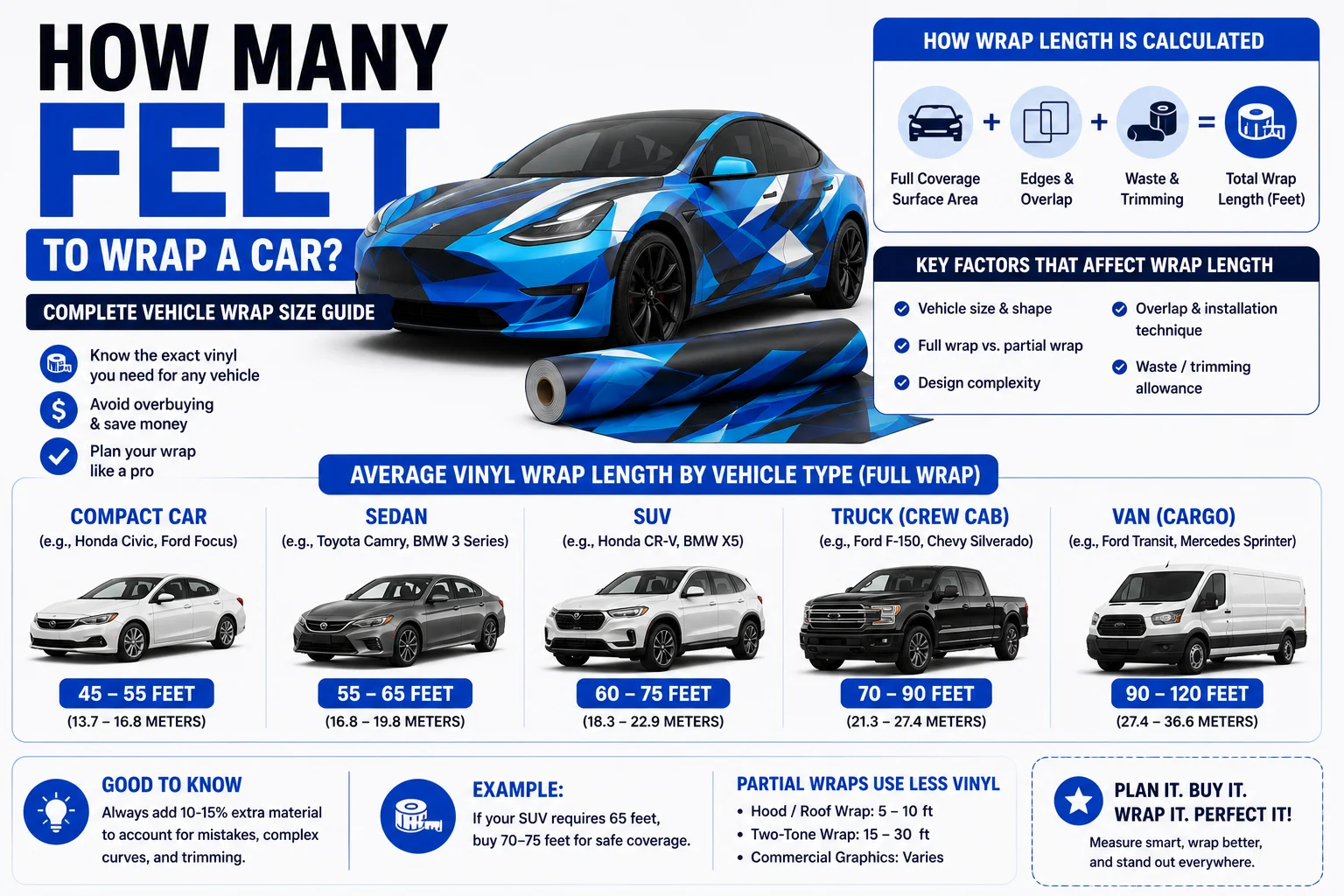
If you are asking how many feet to wrap a car, the answer is not a single fixed number. It depends on the size of the vehicle, the type of wrap, and whether you are doing a full wrap or a partial wrap.
However, most professionals estimate that a full car wrap requires between 50 and 75 feet of vinyl material, depending on roll width and vehicle size.
To understand this properly, we need to break down how wraps are measured, how professionals calculate material, and what changes the total amount needed.
The Short Answer: How Much Vinyl to Wrap a Car
On average:
- Small car: 50–55 feet of vinyl
- Midsize car: 55–65 feet of vinyl
- SUV or truck: 65–75+ feet of vinyl
50 \text{ to } 75\ \text{linear feet of vinyl (typical full car wrap range)
So when people ask how many feet to wrap a car, the most accurate general answer is:
👉 About 60 feet of vinyl on average
Why Car Wraps Are Measured in Square Feet (Not Just Feet)
Even though people say “feet of wrap,” professionals actually calculate wraps using square footage.
Area=Length×Width
This is because vinyl wrap comes in rolls with fixed widths (commonly 5 feet wide).
So installers calculate:
- Car surface area (square feet)
- Plus extra material for curves and overlaps
Then convert that into roll length.
Average Car Surface Area (Realistic Estimate)
Most passenger vehicles have an exterior surface area of:
- Compact car: 200–250 sq ft
- Sedan: 250–300 sq ft
- SUV: 300–400 sq ft
- Truck: 350–450+ sq ft
But not all surfaces are flat or usable, so installers add waste material.
How Much Vinyl to Wrap Different Vehicles
Small Cars (Compact Cars & Hatchbacks)
Examples: Toyota Corolla, Honda Civic
- Material needed: 50–55 feet
- Surface area: ~200–250 sq ft
- Easier curves and fewer panels
These are the most affordable to wrap due to smaller surface area.
Midsize Cars (Sedans)
Examples: Toyota Camry, Honda Accord
- Material needed: 55–65 feet
- Surface area: ~250–300 sq ft
60 feet average vinyl requirement for midsize cars
This is the most common category for car wraps.
SUVs and Crossovers
Examples: Toyota RAV4, BMW X5
- Material needed: 65–75 feet
- Surface area: ~300–400 sq ft
SUVs require more vinyl due to:
- Larger panels
- Taller height
- More curves
Trucks and Vans
Examples: Ford F-150, Mercedes Sprinter
- Material needed: 70–85+ feet
- Surface area: 350–450+ sq ft
These are the most material-intensive vehicles to wrap.
How Professionals Calculate Wrap Material
Installers do not guess—they use a structured approach:
Step 1: Measure vehicle dimensions
- Length
- Height
- Width
Step 2: Estimate surface area
Approximate surface area≈Length×Height×2
Step 3: Add waste factor
- 10%–20% extra for trimming
- More for complex curves
Step 4: Convert to roll length
Since vinyl is typically 5 ft wide:
- 200 sq ft ≈ 40 ft of vinyl
- 300 sq ft ≈ 60 ft of vinyl
- 400 sq ft ≈ 80 ft of vinyl
Full Wrap vs Partial Wrap
Full Wrap
Covers the entire exterior:
- Requires 50–85 feet of vinyl
- Includes bumpers, doors, hood, roof
Partial Wrap
Only selected areas:
- Hood only: 10–15 ft
- Roof only: 10–20 ft
- Side panels: 20–40 ft
Partial wraps are popular for branding and cost savings.
Waste Factor: Why Extra Vinyl Is Needed
Even skilled installers need extra material because:
- Curved surfaces stretch vinyl
- Errors in cutting happen
- Panels overlap
- Complex shapes require repositioning
Typical waste allowance:
- Beginners: 20% extra
- Professionals: 10–15% extra
Real-World Example
Full Sedan Wrap
- Car: Honda Accord
- Base estimate: 55 ft
- Waste factor: 10 ft
55+10=65 feet total vinyl required
Cost vs Material Relationship
Wrap pricing depends heavily on material usage:
- Vinyl cost per foot: $10–$30+ depending on brand
- Labor: $1,000–$3,000+ for full wrap
More feet = higher total cost.
Common Mistakes When Estimating Wrap Size
Confusing linear feet with square feet
Wraps are 3D surfaces, not flat strips.
Ignoring vehicle complexity
Bumpers and mirrors require extra material.
Not adding waste factor
This leads to shortages mid-installation.
Buying wrong roll width
Most wraps are 60 inches wide, but not all.
Expert Tips
- Always measure vehicle before ordering vinyl
- Buy at least 10–15% extra material
- Choose high-quality vinyl for easier installation
- Practice on flat panels before wrapping curves
- Work in controlled temperature environments
FAQs
1. How many feet to wrap a car?
Most cars require 50–75 feet of vinyl.
2. How many square feet is a full car wrap?
About 250–400 square feet depending on vehicle size.
3. Can I wrap a car myself?
Yes, but it requires skill and proper tools.
4. How long does a car wrap last?
Typically 3–7 years depending on material quality.
5. What is the cheapest vehicle to wrap?
Compact cars are the cheapest due to lower material needs.
Conclusion
So, how many feet to wrap a car? The realistic answer is about 50 to 75 feet of vinyl, depending on vehicle size and complexity.
Smaller cars need less material, while SUVs and trucks require significantly more. Since wraps are calculated using surface area and roll width, professionals always convert everything into square feet before determining final material length.
Understanding this helps you budget correctly, avoid material shortages, and plan a successful vehicle wrap project with confidence.